
Digital Marketing Fundamentals: A Complete Framework for Strategy, Channels, and Search Optimization
Table of Contents
Understanding Digital Marketing Fundamentals
Digital marketing fundamentals comprise the foundational concepts, strategic channels, and measurement frameworks required to connect with target audiences across electronic platforms. At its core, digital marketing encompasses all promotional activities executed through internet-connected devices, leveraging data analytics to attract, engage, retain, and convert prospective customers
The transition from traditional marketing to digital marketing represents a shift in communication architecture. Traditional marketing relies on offline broadcast media—such as print publications, television ads, radio broadcasts, and billboards—to push static messages to broad, unsegmented audiences. Conversely, digital marketing operates through dynamic, interactive environments that enable direct audience segmentation, bidirectional communication, real-time campaign adjustments, and granular ROI tracking.
Digital marketing strategies integrate closely with inbound marketing, a methodology focused on attracting qualified prospects by creating contextual content and tailored experiences. Rather than interrupting consumers with unsolicited messages, inbound digital strategies establish brand authority by addressing user needs at the moment solutions are actively sought. Modern digital assets fall into three distinct media classifications:
Owned Media: Digital channels directly owned and controlled by the organization, such as corporate websites, blogs, organic social media profiles, and proprietary email subscriber lists.
Earned Media: Organic exposure gained through third-party endorsement, such as word-of-mouth recommendations, social media shares, editorial press coverage, customer reviews, and backlink referrals.
Paid Media: External promotional placements requiring direct financial investment, including search engine pay-per-click ads, sponsored social posts, banner ads, and paid influencer partnerships.
These media categories adapt the traditional marketing mix—the 4 Ps of Product, Price, Place, and Promotion, expanded to the 7 Ps for service environments—into digital ecosystems. “Place” expands from physical storefronts to mobile applications and optimized web stores, while “Promotion” shifts from one-way advertising to automated, multi-channel customer journeys.
| Media Category | Primary Ownership & Control | Operational Mechanism | Strategic Examples | Core Business Value |
| Owned Media | Full organizational control | Direct publishing and asset management | Company website, corporate blog, email list | Builds long-term authority and customer relationships |
| Earned Media | Third-party audiences and publishers | Organic amplification, viral sharing, and PR | Unsolicited reviews, media features, backlinks | Delivers high credibility and social validation |
| Paid Media | Ad networks and publisher platforms | Bidding auctions and sponsored placements | Google Search Ads, Meta sponsored posts, display banners | Generates immediate targeted traffic and measurable scale |
Audience Architecture and Buyer Journey Dynamics
Effective digital marketing strategies rely on structured audience profiling rather than generalized demographic assumptions. Organizations build actionable buyer personas—semi-fictional representations of ideal customers derived from customer relationship management (CRM) data, analytical tools, and qualitative buyer interviews. Constructing a buyer persona involves analyzing five structural dimensions:
- Demographic Profiles: Structural attributes such as age, geographic location, professional job titles, industry sectors, and income ranges.
- Operational Pain Points: Explicit functional, technical, or financial obstacles the prospect experiences that require external resolution.
- Primary Goals and Aspirations: Desired operational outcomes or personal milestones defining success for the buyer.
- Channel Preferences: Specific digital platforms, social networks, search engines, and publication formats preferred during research hours.
- Purchasing Objections: Friction points, budget constraints, governance requirements, or trust barriers that delay commercial transactions.
The buyer journey represents the cognitive process a customer goes through from recognizing a problem to purchasing a solution. Digital content mapping aligns specific educational assets with the prospect’s psychological state across three core lifecycle stages.
In the Awareness Stage, the prospect identifies symptoms of a challenge or opportunity. The marketing objective is educational, providing value-first content that defines the problem without pitching products directly. Effective formats include educational blog posts, whitepapers, industry research, and explainer videos.
In the Consideration Stage, the prospect clearly defines their problem and evaluates available methodologies or solution categories. The marketing objective is comparative, demonstrating why a specific solution framework effectively addresses the issue. Effective formats include expert webinars, product comparison guides, case studies, and detailed e-books.
In the Decision Stage, the prospect selects a specific solution vendor and prepares to execute a commercial transaction. The marketing objective is conversion, overcoming final purchasing objections and validating return on investment. Effective formats include live product demonstrations, free trials, ROI calculators, custom proposals, and customer testimonials.
| Lifecycle Stage | Buyer Cognitive Mindset | Strategic Marketing Objective | Optimal Content Formats |
|---|---|---|---|
| Top of Funnel (Awareness) | Identifying symptoms of an operational problem | Educate on the problem without aggressive selling | Educational blog posts, industry whitepapers, research reports, videos |
| Middle of Funnel (Consideration) | Evaluating distinct solution categories and approaches | Demonstrate solution framework efficacy | Expert webinars, comparison guides, case studies, e-books |
| Bottom of Funnel (Decision) | Selecting a specific vendor for commercial transaction | Validate ROI and drive commercial conversion | Product demos, free trials, ROI calculators, sales consultations |
Core Digital Marketing Channels
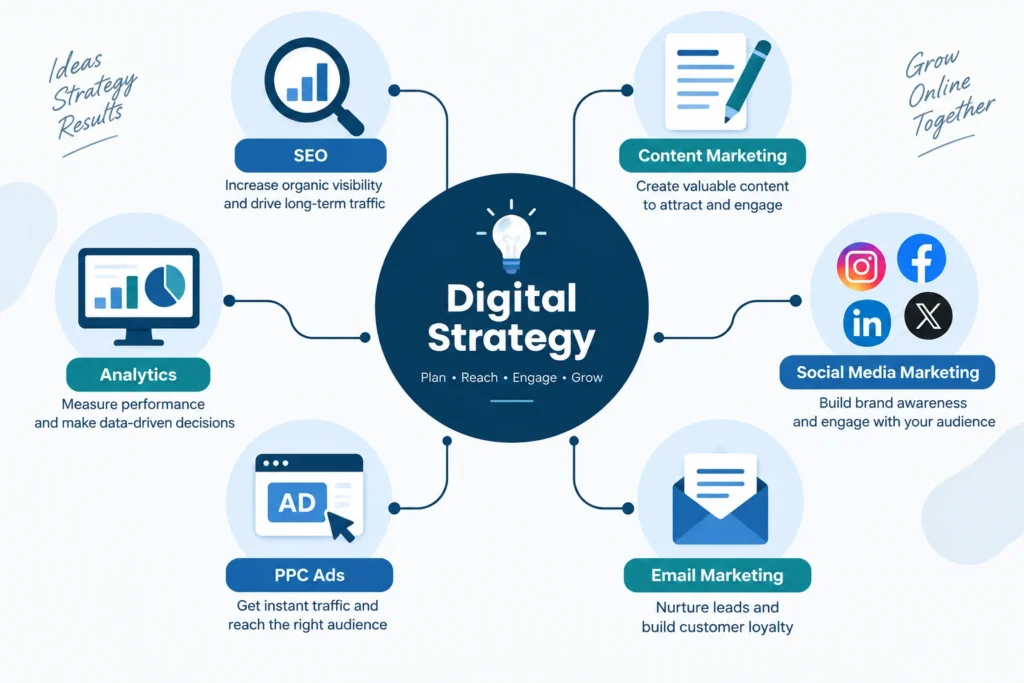
Search Engine Optimization (SEO)
Search Engine Optimization involves refining web assets to increase organic visibility within search engine results pages (SERPs) for targeted user queries. Organic search accounts for over 50% of total website traffic, with the top three search positions capturing approximately 54% of user clicks. Unlike paid advertising, organic ranking creates compounding asset equity that drives continuous passive traffic over extended timeframes.
Managing SEO effectively requires balancing four distinct sub-disciplines:
- Technical SEO: Optimizing website backend infrastructure so search engine crawlers (such as Googlebot) can discover, parse, and index web pages efficiently. Core components include clean site architecture, XML sitemaps, robots.txt directives, canonical tags, HTTPS protocols, and JavaScript rendering optimization.
- On-Page SEO: Structuring page elements to communicate topical relevance to search algorithms. Primary activities involve strategic keyword integration across title tags, main headings (H1, H2), descriptive meta descriptions, clean URL structures, internal linking, and image alt attributes.
- Off-Page SEO: Enhancing domain authority and trust through external signals. The main mechanism involves acquiring high-quality backlinks from authoritative external websites, which act as digital endorsements.
- User Experience (UX) & Mobile Performance: Ensuring rapid page loading speeds, responsive layouts, intuitive site navigation, and mobile usability.
Search Engine Marketing (SEM) and Paid Advertising
Pay-Per-Click (PPC) advertising allows businesses to purchase immediate visibility across search engines and advertising networks. Advertisers bid on specific keywords and targeting criteria in real-time auctions, paying fees only when a user actively clicks an ad unit. PPC provides precise targeting control and immediate traffic, making it ideal for product launches, time-sensitive campaigns, and capturing high-intent commercial queries.
Paid advertising formats span several key digital touchpoints:
- Search Ads: Text-based listings displayed above organic search results that target specific commercial keywords.
- Display Ads: Visual banner promotions distributed across third-party publisher sites based on user interests and demographics.
- Shopping Ads: Product listings displaying images, prices, merchant details, and reviews directly within SERPs.
- Retargeting Ads: Advertisements served to users who previously visited an organization’s website, reinforcing brand recall and recapturing abandoned sessions.
Content Marketing Frameworks
Content marketing is an education-first strategy focused on creating, publishing, and distributing valuable content to attract and retain a defined audience. Content marketing builds long-term topical authority and solves audience challenges rather than pitching products directly. Managing content requires structured workflows governing ideation, production, editorial review, publication, and distribution. Operational frameworks establish style guidelines, clarify team roles, and utilize editorial calendars to maintain posting consistency across blogs, podcasts, video channels, and downloadable assets.
Social Media Marketing
Social media marketing utilizes platforms such as LinkedIn, Instagram, Meta, X, and TikTok to build brand visibility, engage communities, and direct web traffic. Strategic focus varies significantly across B2B and B2C environments:
- B2B Contexts: Focus primarily on professional platforms like LinkedIn to share industry research, publish long-form thought leadership, network with key decision-makers, and capture qualified business leads.
- B2C Contexts: Emphasize visual platforms like Instagram and TikTok to showcase lifestyle branding, short-form video content, influencer collaborations, and direct e-commerce shopping integrations.
Organic social media builds community trust and organic dialogue, while paid social advertising amplifies content reach to specific buyer segments beyond existing follower bases.
Direct Nurturing: Email, Mobile, and Partner Channels
Direct communication channels allow businesses to engage audiences directly, without intermediate social algorithms:
- Email Marketing: Delivers high ROI by sending personalized messages directly to subscriber inboxes. Execution depends on subscriber list segmentation, automated lifecycle campaigns, newsletter value, and targeted offers.
- Mobile Marketing: Reaches users on smartphones and tablets through responsive web design, dedicated applications, SMS communications, and location-based notifications.
- Influencer & Affiliate Marketing: Leverages external creators and strategic partners to reach target audiences. Influencer marketing collaborates with creators classified by audience scale—Nano (1k–10k), Micro (10k–100k), Mid-tier (100k–500k), and Macro (500k–1M)—to leverage niche credibility. Affiliate marketing operates on performance-based revenue sharing, paying partners commissions for verified lead or sale conversions.
| Digital Channel | Primary Operational Focus | Core Strategic Value | Investment Model | Primary Metrics |
| SEO | Organic search optimization | Compounding long-term organic traffic | Resource-intensive; low marginal cost | Organic Clicks, Rankings, Authority |
| PPC Advertising | Paid search auction bidding | Immediate, high-intent traffic | Continuous variable ad spend | CTR, CPC, Conversion Rate, CPA |
| Content Marketing | Audience education & asset publishing | Authority building & lead capture | Creative production overhead | Organic Visits, Asset Downloads |
| Social Media | Community engagement & social reach | Brand awareness & engagement | Scalable organic and paid media | Engagement Rate, Reach, Impressions |
| Email Marketing | Direct audience communication | High-ROI conversion & retention | Platform subscription software cost | Open Rate, Click-to-Open, Conversions |
| Influencer Marketing | Creator audience partnerships | Brand endorsement & niche trust | Performance fee or flat payment | Referral Traffic, Attributed Sales |
Generative Search Architectures: E-E-A-T, AEO, and GEO
Search engines have evolved from basic keyword-matching tools into semantic search systems designed to prioritize helpful, reliable, people-first content. Google Search Essentials establishes technical standards and anti-spam policies to protect user experience. Tactics like keyword stuffing, scraped text, and manipulative link schemes lead to algorithmic ranking demotions or search index removal.
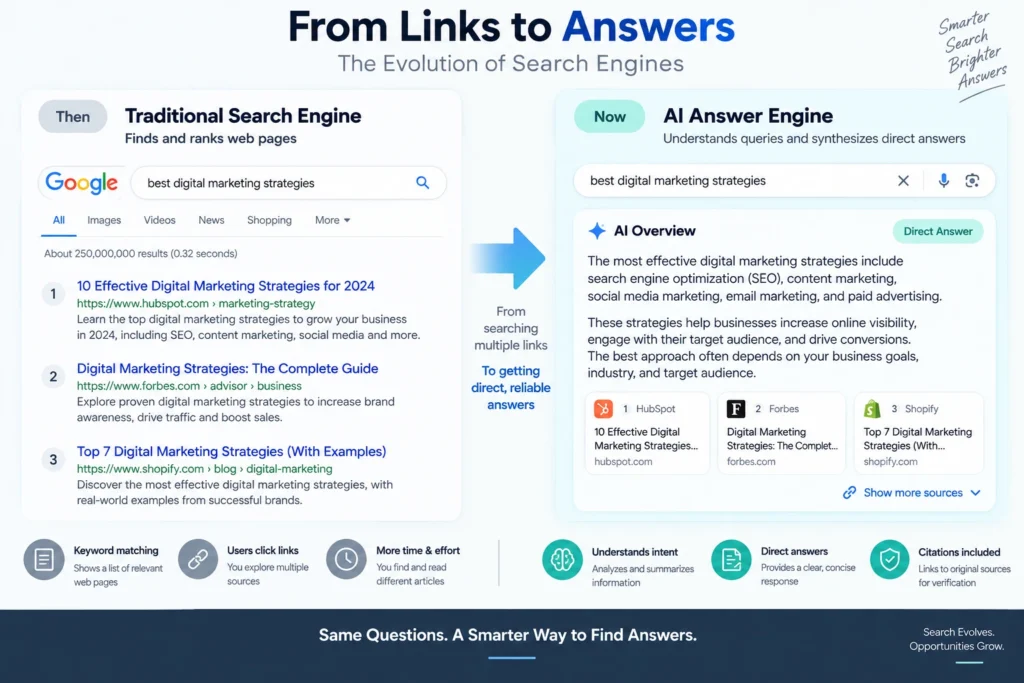
Modern search quality evaluation relies heavily on the E-E-A-T framework:
- Experience: Demonstrating authentic, first-hand experience with the subject matter.
- Expertise: Displaying deep knowledge and domain credentials.
- Authoritativeness: Establishing the content creator and domain as recognized industry sources.
- Trustworthiness: Maintaining transparency, factual accuracy, secure protocols, explicit sourcing, and clear business details.
Digital creators evaluate their content using three core questions:
- Who created the content? Explicit author bylines, expert bios, and verifiable credentials build trust.
- How was the content created? Including original research, direct product testing, or proprietary data rather than rehashing secondary sources.
- Why was the content created? Prioritizing genuine audience value over search engine manipulation.
The rise of AI-assisted search tools—such as Google AI Overviews, ChatGPT, Claude, and Perplexity—has introduced Agentic Search Optimization (ASO) strategies:
- Answer Engine Optimization (AEO): Structuring content so search engines and answer bots can extract direct answers for featured snippets and voice results. AEO relies on clear definition sentences, structured Q&A formats, bulleted lists, comparative Markdown tables, and Schema.org structured data.
- Generative Engine Optimization (GEO): Optimizing brand presence so generative AI systems cite the organization during multi-source response generation. GEO focuses on building broad topical authority, maintaining consistent brand references across platforms, and securing inclusions in industry knowledge graphs.
- Large Language Model Optimization (LLMO): Ensuring brand terminology, research data, and core products are represented in foundational LLM training sets and retrieval-augmented generation (RAG) indexes.
| Optimization Discipline | Target System | Core Objective | Key Optimization Tactics |
| SEO | Search Engine Crawlers & SERPs | Rank web page URLs for user search queries | Keywords, backlink acquisition, technical site speed, metadata |
| AEO | Answer Engines & Featured Snippets | Provide direct text answers for snippet extraction | Direct definitions, bulleted lists, structured Schema markup |
| GEO / LLMO | Generative AI Models & RAG Engines | Secure brand citations in AI-generated answers | Topical depth, entity relationships, broad citation coverage |
Strategic Planning, Budgeting, and Performance Metrics
Connecting digital marketing tactics to core business outcomes requires setting explicit SMART goals:
- Specific: Target concrete business outcomes (e.g., increase organic lead acquisition).
- Measurable: Establish clear numerical tracking benchmarks (e.g., generate 50 qualified leads monthly).
- Achievable: Set realistic goals based on current resources and market conditions.
- Relevant: Ensure goals directly support overarching corporate strategy.
- Time-bound: Assign clear completion deadlines (e.g., achieve targets within Q2).
Marketing budgets typically range from 5% to 15% of total company revenue, depending on business growth goals and market maturity. Early-stage firms invest aggressively to build market awareness, while established businesses focus on operational efficiency and channel optimization. Capital allocation spans three core areas:
- Paid Media: Ad spend dedicated to search, social, display, and partner networks.
- Tools & Technology: Software subscriptions for analytics platforms, CRM systems, email automation, and SEO research tools.
- Content & Creative Production: Costs for copywriting, graphic design, video production, and specialized external agencies.
Evaluating campaign performance requires tracking both leading indicators (such as traffic and engagement) and lagging business outcomes (such as cost per acquisition and customer lifetime value).
| Key Metric | Calculation Formula | Strategic Purpose |
| Click-Through Rate (CTR) [cite: 10, 12] | $\text{CTR} = \left( \frac{\text{Total Clicks}}{\text{Total Impressions}} \right) \times 100$ | Evaluates ad creative, headline strength, and search listing relevance |
| Cost Per Click (CPC) [cite: 7, 10] | $\text{CPC} = \frac{\text{Total Ad Cost}}{\text{Total Clicks Received}}$ | Measures ad network cost efficiency in paid bidding auctions |
| Conversion Rate [cite: 10, 12] | $\text{Conversion Rate} = \left( \frac{\text{Total Conversions}}{\text{Total Site Visitors}} \right) \times 100$ | Measures user flow efficiency and landing page performance |
| Cost Per Acquisition (CPA) [cite: 12] | $\text{CPA} = \frac{\text{Total Campaign Cost}}{\text{Total Acquired Leads or Customers}}$ | Quantifies direct acquisition spend per conversion action |
| Return on Investment (ROI) [cite: 13] | $\text{ROI} = \left( \frac{\text{Net Campaign Profit}}{\text{Total Digital Marketing Investment}} \right) \times 100$ | Measures overall profitability of digital marketing campaigns |
Implementation Roadmap and Strategic Pitfalls
Establishing a successful digital marketing or digital marketer presence requires a phased execution strategy over twelve months:
- Stage 1: Foundation (Months 1–3): Build a mobile-responsive website with technical SEO best practices, integrate Google Analytics and Search Console, perform target audience keyword research, establish core social media profiles, and set up basic email collection forms.
- Stage 2: Expansion (Months 4–8): Launch targeted PPC search ad campaigns with modest daily budgets, develop downloadable content assets (e-books, templates) to build email subscriber lists, launch automated lead-nurturing email sequences, and publish regular SEO-optimized blog content.
- Stage 3: Optimization (Months 9–12): Analyze channel conversion data, reallocate ad spend toward high-performing tactics, run A/B conversion rate optimization tests on key landing pages, deploy structured schema markup, and adjust content assets for generative search systems.
Organizations can avoid performance bottlenecks by addressing common strategic mistakes:
- Executing Tactics Without Alignment: Running campaigns without clear SMART goals or connection to business revenue targets.
- Single-Channel Dependence: Relying entirely on a single social platform or paid channel, exposing the business to algorithm changes or rising ad costs.
- Focusing on Vanity Metrics: Prioritizing superficial metrics like page views or social likes over conversion rate, CPA, and revenue ROI.
- Ignoring Owned Contact Acquisition: Neglecting first-party email collection, leaving customer communication dependent on third-party ad networks.
- Neglecting Existing Assets: Failing to update legacy website content, causing search engine algorithms to deprioritize stale material over time.