
Off-page SEO plays an important role in building website credibility, earning backlinks, and improving organic visibility. Even if your website has excellent content and technical SEO, getting recognized by relevant websites and audiences can help strengthen its overall online presence.
But off-page SEO in 2026 is not just about creating hundreds of backlinks. It is about building genuine relationships, earning editorial links, increasing brand visibility, and establishing trust.
Here are 15 practical off-page SEO techniques you can use to build sustainable website authority.
Table of Contents
What Is Off Page SEO?
Off page SEO refers to actions taken away from your own site that influence how search engines and AI systems judge your credibility. Backlinks are the biggest part, but brand mentions, reviews, social visibility, and partnerships all contribute.
| On-Page SEO | Off-Page SEO | |
|---|---|---|
| Where it happens | Your website | Other websites and platforms |
| Examples | Content, title tags, internal links, speed | Backlinks, PR, mentions, reviews |
| You control it | Fully | Partially (you earn it) |
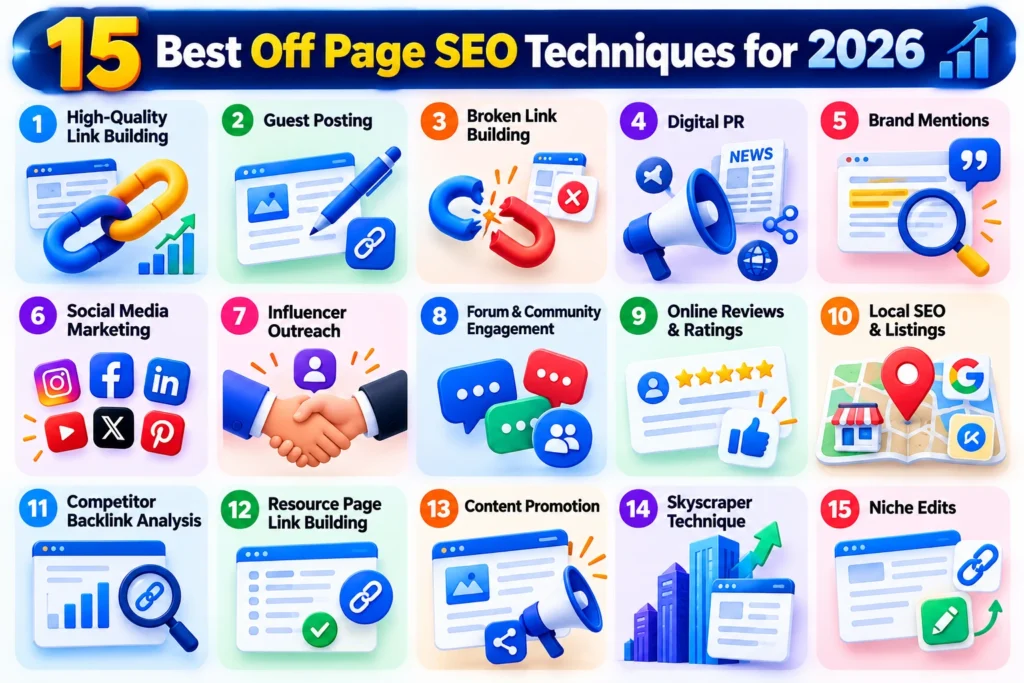
15 Best Off Page SEO Techniques for 2026
1. Create Linkable Assets
People link to things that are useful to cite. Original surveys, free tools, templates, and clear data studies attract links naturally. Before building one, search your topic and ask what is missing that others would reference.
2. Digital PR
Digital PR means pitching newsworthy stories, data, or expert commentary to journalists and publications. A single mention in a respected outlet can carry more weight than dozens of low-quality links. Start with a story angle that is genuinely new, not a press release about routine company news.
3. Guest Posting (Selectively)
Writing for relevant, editorially strict sites can bring links, referral traffic, and exposure. Choose sites your audience actually reads. Avoid sites that accept any article for a fee, since that pattern looks like link selling.
4. Broken Link Building
Find broken outbound links on relevant pages, then offer your working page as a replacement. Steps:
- Find resource pages in your niche.
- Check for dead links with a crawler or browser extension.
- Email the site owner with the broken URL and your suggested alternative.
5. Unlinked Brand Mention Reclamation
When a site mentions your brand without linking, politely ask them to add the link. This converts goodwill that already exists, and response rates tend to be better than cold outreach.
6. Expert Quotes and Journalist Requests
Journalists regularly look for expert comments. Answer relevant requests quickly, with concise, specific insights. Platforms for this change over time, so check which are active before committing.
7. Resource Page Link Building
Many sites curate “best resources” or “useful tools” pages. If your content is genuinely better or fills a gap, suggest it with a short, personal email.
8. Podcast and Interview Appearances
Podcast guest spots and interviews usually include a link in the show notes plus audience exposure. They also build the personal authority that supports E-E-A-T.
9. Social Media and Community Engagement
Social links are generally treated as nofollow, so they are not a direct ranking lever. Their value lies in content discovery, which can lead to real links from people who find your work. Participate in communities like LinkedIn, Reddit, and Quora by contributing helpfully rather than dropping links.
10. Local Citations and Google Business Profile
For businesses serving a location, consistent name, address, and phone details across trusted directories support local visibility. Keep your Google Business Profile complete and accurate.
11. Relevant Business Directories
Submit to industry-specific or reputable directories only. Skip bulk submission lists, which offer little value and can look manipulative.
12. Reviews and Reputation Management
Reviews on Google, Trustpilot, G2, or industry platforms shape trust for users and for AI systems summarizing your brand. Ask satisfied customers for honest reviews and respond professionally to criticism.
13. Influencer and Creator Collaboration
Working with creators in your niche can lead to mentions, tutorials, and links. Treat it as audience-building. If you pay or send free products, ensure links carry the appropriate rel attribute (see mistakes below).
14. Competitor Backlink Analysis
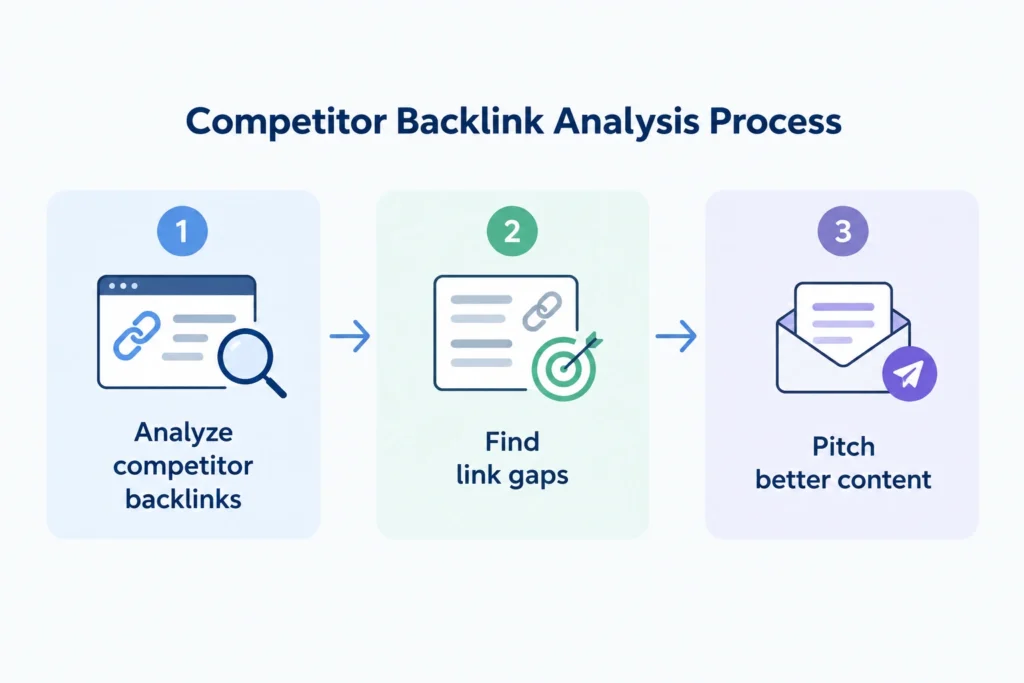
Review where competitors earn links using a backlink tool, then identify patterns: guest posts, roundups, tools, or press coverage. Replicate the approach with better content, not copied tactics.
15. Webinars, Events, and Partnerships
Co-hosting webinars, speaking at conferences, or partnering with complementary brands often earns mentions and links from event pages and partner sites. These links come from real relationships, which is why they hold up over time.
Comparison: Which Off-Page SEO Techniques Should You Prioritize?
| Technique | Main objective | Difficulty |
|---|---|---|
| Quality backlinks | Authority | Medium |
| Guest posting | Editorial exposure | Medium |
| Digital PR | Brand credibility | High |
| Broken link building | Relevant backlinks | Medium |
| Competitor analysis | Discover opportunities | Easy |
| Link-worthy content | Natural backlinks | Medium |
| Brand mentions | Brand recognition | Easy |
| Expert roundups | Industry visibility | Medium |
| Podcasts | Audience growth | Medium |
| Partnerships | Relationships | Medium |
| Local citations | Local visibility | Easy |
| Customer reviews | Reputation | Easy |
| Online communities | Engagement | Easy |
| Social media | Content distribution | Easy |
| Content repurposing | Wider reach | Easy |
Common Off Page SEO Mistakes
- Buying links. Google’s spam policies treat paid links that pass ranking signals as a violation. Paid or sponsored links should use rel=”sponsored”.
- Chasing quantity. One relevant, trusted link beats many irrelevant ones.
- Over-optimized anchor text. Natural, varied anchors look safer than repeated exact-match phrases.
- Ignoring user-generated links. Links from comments and forums should use rel=”ugc” or nofollow where applicable.
- Using private blog networks or mass-produced guest posts. These patterns are what link spam systems are built to detect.
- Never auditing your profile. Review new backlinks periodically. Disavowing is rarely needed and is meant for cases of manipulative links you cannot remove.
How to Measure Off Page SEO
Track referring domains, link relevance, branded search growth, referral traffic, and keyword rankings. Third-party authority scores (such as Domain Authority) are tool-specific estimates, not Google metrics, so treat them as directional only.
Conclusion
The 15 best off page SEO techniques for 2026 share one idea: earn attention from credible people and sites by being genuinely useful. Pick two or three techniques that fit your resources, execute them consistently, and measure results before adding more. A good first step is checking where your brand is already mentioned without a link.