
How to Leverage Artificial Intelligence for Digital Marketing in 2026
Artificial intelligence for digital marketing has moved from simple automated text generation to autonomous execution systems, predictive analytics, and real-time audience engine optimization. Modern marketing channels require rapid iteration, hyper-personalized messaging, and multi-modal creative assets that human teams alone cannot scale efficiently.
Understanding how to deploy AI models effectively determines whether a brand captures market share or falls behind competitors operating with lower overhead and faster speed-to-market. This guide breaks down how AI works across core marketing channels, the primary tools driving the industry, essential human skills required to manage these systems, and strategic frameworks for balancing technology with human oversight.
Key Takeaways
- Core Definition: AI in digital marketing uses machine learning, predictive analytics, and generative models to automate media buying, content production, audience segmentation, and performance optimization.
- Operational Shift: Success relies on using AI as an execution engine while humans handle strategic direction, data auditing, brand governance, and positioning.
- Top Tool Categories: Leading platforms concentrate on predictive ad bidding, generative search optimization (GEO), agentic content workflows, and automated customer journey orchestration.
- Job Evolution: AI replaces repetitive execution tasks rather than marketers themselves. High-demand skills now center on prompt architecture, marketing analytics, data governance, and strategic framing.
Table of Contents
What Is AI in Digital Marketing and How Is It Used?
Artificial intelligence in digital marketing refers to using machine learning models, natural language processing (NLP), computer vision, and predictive algorithms to analyze marketing data, automate decisions, and create personalized customer experiences at scale.
Marketers use these technologies to eliminate manual data crunching and scale creative output without compromising performance quality.
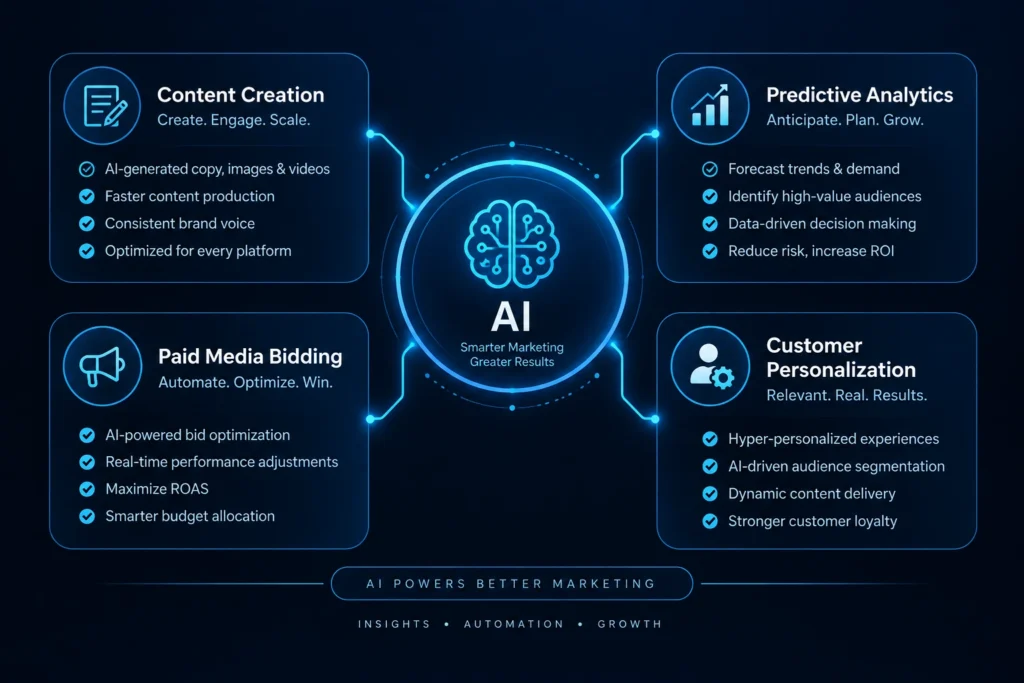
Common Practical Applications:
- Predictive Audience Targeting: Machine learning algorithms evaluate historical user behavior to predict purchase intent and automatically adjust ad bids in real time.
- Generative Content Scaling: AI models produce baseline copy, ad variations, social graphics, and video storyboards from single source briefs.
- Conversational Commerce: Natural language agents answer complex buyer queries, resolve support tickets, and guide website visitors through conversion funnels.
- Dynamic On-Page Personalization: Systems alter website headlines, product recommendations, and call-to-action buttons based on visitor demographic data and browsing history.
Top AI Tools Shaping Digital Marketing Operations
Selecting the right software stack depends on whether a business prioritizes paid media automation, search engine optimization, or multi-channel creative output.
| Category | Primary Use Case | Leading Platforms | Key Operational Benefit |
| Search & AEO/GEO | Search generative optimization & intent modeling | Perplexity Enterprise, BrightEdge, MarketMuse | Identifies generative answer patterns and search engine entity gaps. |
| Paid Media & Bidding | Real-time budget allocation & creative testing | Google Performance Max, Meta Advantage+, Smartly.io | Automates bid adjustments and asset combination testing at scale. |
| Content & Copywriting | Rapid draft creation & multi-channel repurposing | Jasper, Claude, Copy.ai | Accelerates content production workflows with brand-voice governance. |
| Creative & Design | Visual asset, banner, and video generation | Midjourney, Adobe Firefly, Runway | Reduces asset production timelines from weeks to hours. |
| Marketing Automation | Predictive customer journeys & lead scoring | HubSpot AI, Salesforce Einstein, Klaviyo | Delivers personalized emails and triggers based on behavioral data. |
Examples of AI Implementation Across Marketing Channels
Understanding abstract concepts requires seeing how enterprise brands and growth marketers apply these algorithms in daily workflows.
1. Organic Search, AEO, and GEO
Traditional search engine optimization now operates alongside Answer Engine Optimization (AEO) and Generative Engine Optimization (GEO). AI tools audit how language models parse brand entities, ensuring companies appear in direct search answers provided by AI-driven discovery engines. Marketers use structured data generators to deliver clear context directly to search crawlers.
2. Performance Media Management
Ad platforms utilize neural networks to process user signals—such as time of day, device type, past conversion history, and cross-site activity—to place bids within milliseconds. Marketers input multiple images, headlines, and descriptions, allowing platform algorithms to test thousands of variations and allocate budget to top-performing combinations automatically.
3. Hyper-Personalized Email Campaigns
E-commerce brands deploy predictive AI to analyze purchasing frequency and product category preferences. Instead of sending generic newsletters, these platforms generate dynamic email blocks containing product recommendations tailored specifically to each individual recipient’s predicted repurchase timing.
The Pros and Cons of AI in Digital Marketing
Deploying automated systems offers major competitive advantages, but relying on them without human management creates operational risks.
Advantages
- Scalability: Teams can produce multi-channel assets and localized campaign variations in minutes rather than weeks.
- Data-Driven Precision: Machine learning identifies subtle patterns across millions of consumer touchpoints that human analysts miss.
- Continuous Optimization: Ad algorithms reallocate spending dynamically based on live conversion data, reducing wasted ad spend.
Disadvantages
- Quality & Accuracy Risks: Large language models occasionally state incorrect information as fact, requiring mandatory human auditing before publishing.
- Brand Dilution: Over-relying on standard prompts produces generic content that fails to differentiate a brand from its competitors.
- Data Privacy Concerns: Uploading proprietary customer data into unvetted or non-compliant public AI platforms creates severe legal and security vulnerabilities.
Essential Skills for the AI-Driven Digital Marketer
The rise of automation does not remove the need for human talent; it changes the underlying skill set required to drive performance.
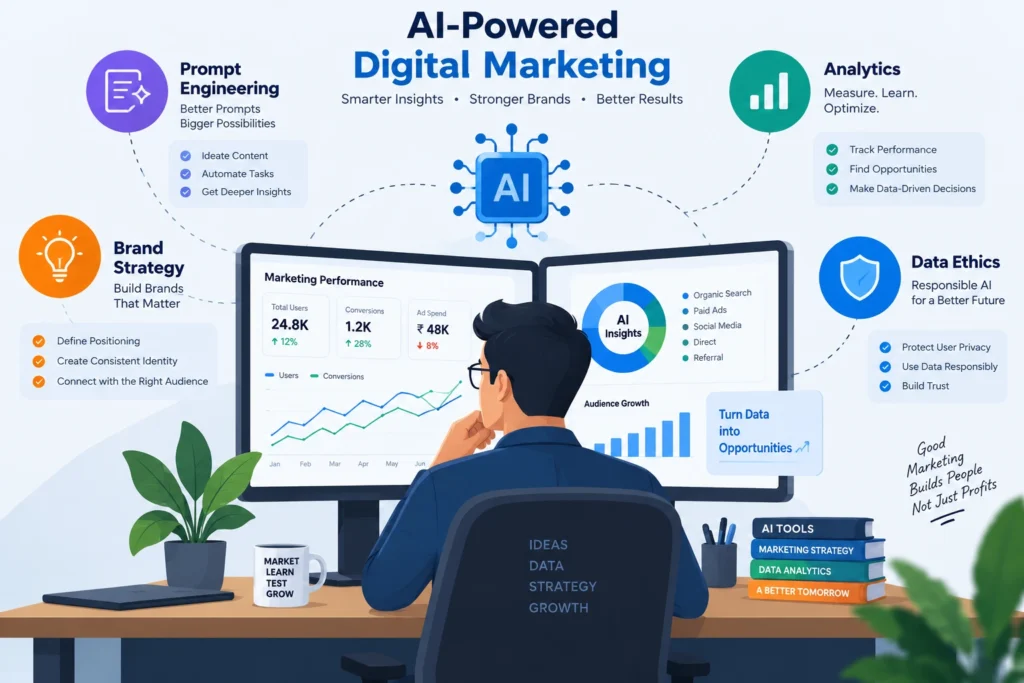
Key Skills in Demand:
- Prompt Architecture & Context Framing: Writing precise system directives and context frames to guide language models toward accurate, brand-aligned outputs.
- Data Auditing & Quality Assurance: Reviewing automated insights, fact-checking AI content, and verifying data pipelines for accuracy.
- AEO & GEO Strategy: Structuring content with clear entity relationships, schema markup, and concise factual answers optimized for AI discovery platforms.
- Marketing Technology (MarTech) Integration: Connecting AI tools via APIs to standard CRMs, analytics suites, and execution software.
- Strategic Brand Positioning: Crafting unique value propositions, emotional storytelling, and positioning strategies that AI models cannot replicate.
Will Artificial Intelligence Replace Digital Marketers?
AI will not replace digital marketers, but marketers who leverage AI effectively will replace those who do not.
Automated systems excel at speed, pattern recognition, and processing data at scale. However, they lack emotional intelligence, real-world experience, strategic intuition, and genuine cultural context. Marketers who focus entirely on manual execution—such as basic copywriting or mechanical data entry—face high automation risks. Conversely, strategists, brand directors, media buyers, and analytics leads who direct AI execution engines become significantly more valuable to organizations.
The Future of AI in Digital Marketing
The future of digital marketing centers on autonomous agentic workflows and direct consumer-to-AI search behaviors.
Marketing platforms are shifting from simple prompt-based assistants to autonomous AI agents capable of planning, executing, and auditing multi-step campaigns with minimal human intervention. Additionally, consumer discovery continues moving toward conversational answer engines. Success requires brands to optimize their digital presence so AI research agents can easily parse, trust, and cite their products and services directly within generated answers.
Practical Action Steps for Implementation
- Audit Repetitive Tasks: Identify manual, time-consuming activities like reporting, baseline drafting, and tag management that can be automated immediately.
- Establish Governance Rules: Define strict data privacy guidelines outlining what customer data can and cannot be entered into third-party AI software.
- Build an Human-In-The-Loop (HITL) Workflow: Implement mandatory human reviews for all AI-generated content and creative assets to protect brand integrity.
- Optimize for AI Search Engines: Add structured JSON-LD schema, clear bulleted summaries, and explicit factual statements across core web pages to capture generative search traffic.
Conclusion
Integrating artificial intelligence for digital marketing is no longer optional for brands seeking efficient growth. By delegating data analysis, bidding optimization, and content drafting to machine learning systems, marketing teams free up critical resources to focus on high-level strategy, creative direction, and audience relationships. Success belongs to marketers who treat AI as a powerful execution partner while maintaining tight human editorial control.
Start by selecting one channel—such as paid ad creative testing or content summarization—and build a structured human-in-the-loop workflow today.