

Complete SEO Guide for Beginners in 2026 (Step-by-Step)
If you are a college student, business owner, freelancer, or beginner trying to understand SEO, the first step is learning how search engines discover, understand, and rank web pages.
This complete SEO guide for beginners in 2026 explains the foundation of SEO, including keyword research, on-page SEO, technical SEO, content optimization, links, Search Console, and practical ways to start improving a website.
Google’s current guidance continues to emphasize useful, reliable, people-first content rather than content created primarily to manipulate rankings.
Table of Contents
What Is SEO?
Search Engine Optimization (SEO) is the process of improving a website and its content so search engines can better understand it and users can find relevant information through organic search.
SEO is not simply adding keywords to a page. A practical SEO strategy combines content quality, search intent, website structure, technical accessibility, internal linking, and ongoing measurement.
Think of SEO as a bridge:
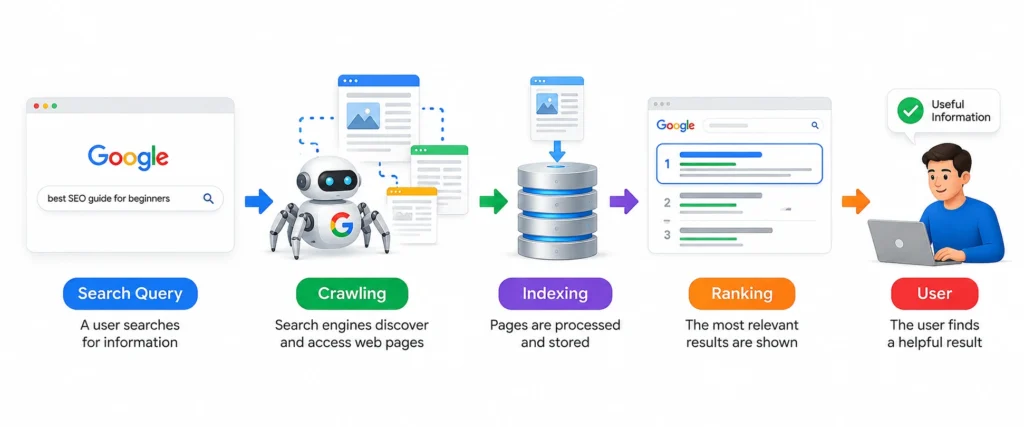
Search query → Search engine → Relevant webpage → Useful experience
How Does Google Search Work?
At a basic level, Google Search needs to discover pages, understand their content, and decide which results are useful for a particular query.
Three concepts are essential:
| Concept | Meaning |
|---|---|
| Crawling | Search engines discover and access web pages |
| Indexing | Information about accessible pages is processed and stored |
| Ranking | Search results are ordered based on relevance and other signals |
SEO cannot guarantee a specific ranking position. Instead, your goal should be to make your website accessible, understandable, relevant, and genuinely useful.
SEO Foundations Every Beginner Should Learn
1. Keyword Research
Keyword research identifies the words and phrases people use when searching for information, products, or services.
For example, instead of targeting only “SEO,” a beginner website could target more specific searches such as:
- SEO guide for beginners
- how to do keyword research
- on-page SEO checklist
- technical SEO basics
- SEO tools for beginners
Look beyond search volume. Consider search intent, relevance, competition, and what the searcher actually wants to accomplish.
2. Search Intent
Search intent is the reason behind a search query.
Common types include:
- Informational: “What is SEO?”
- Commercial: “Best SEO tools”
- Transactional: “Buy SEO software”
- Navigational: “Google Search Console”
Your page should satisfy the intent behind the query rather than simply repeat the keyword.
3. On-Page SEO
On-page SEO focuses on elements you can improve directly on a webpage.
Important areas include:
- Clear page title
- Helpful headings
- Relevant and natural keywords
- Descriptive URLs
- Useful internal links
- Original, valuable content
- Descriptive image alt text
- Easy-to-read formatting
A strong page should make its topic clear to both readers and search engines.
4. Technical SEO
Technical SEO focuses on how your website is accessed, crawled, rendered, and understood.
Beginner-level technical SEO includes:
- Mobile-friendly pages
- Crawlable links
- Proper indexing controls
- XML sitemaps where appropriate
- HTTPS
- Clean website architecture
- Canonicalization where needed
- Fast and usable pages
Google provides technical requirements and Search documentation to help website owners understand these areas.
5. Internal Linking
Internal links connect pages on your own website.
For example, an article about keyword research could naturally link to another article about on-page SEO.
Good internal linking can help users discover related information while also helping search engines understand relationships between pages.
6. Backlinks and Off-Page SEO
A backlink is a link from another website to your website.
Links can help search engines discover pages and understand relationships between websites. However, beginners should avoid treating link building as a numbers game.
Focus on earning relevant links through:
- Useful original content
- Industry resources
- Digital PR
- Genuine partnerships
- Research or useful data
- Expert contributions
Avoid manipulative link schemes and other practices that violate Google’s spam policies.
Essential SEO Tools for Beginners
You do not need dozens of paid tools to begin learning SEO.
| Tool | Beginner Use |
|---|---|
| Google Search Console | Search performance and indexing |
| Google Analytics | Website traffic and user behavior |
| Google Trends | Search interest and topic research |
| Google Search | Understanding real search results |
| Screaming Frog | Technical website auditing |
| Ahrefs / Semrush | Keyword and backlink research |
Google Search Console is particularly useful because it provides information about how a website performs in Google Search and whether Google can index its pages.

A Simple SEO Workflow for Beginners
If you are starting from zero, follow this sequence:
- Choose a clear topic or business niche.
- Research relevant search queries.
- Understand the search intent.
- Create genuinely useful content.
- Optimize titles, headings, URLs, images, and internal links.
- Check technical SEO problems.
- Submit or monitor your website through Search Console.
- Measure impressions, clicks, queries, and pages.
- Improve content based on real performance and user needs.
This approach gives you a foundation before moving into advanced SEO.
SEO in 2026: What Beginners Should Understand
SEO in 2026 is not simply about traditional blue-link rankings. Google Search continues to develop features involving AI-generated search experiences, while Search Central documentation continues to evolve.
That does not mean beginners should abandon fundamental SEO.
The foundation remains:
Useful content + clear information + technically accessible website + strong structure + trustworthy signals + continuous improvement.
Google also states that scaled content created primarily to manipulate search rankings can violate its spam policies, including large amounts of unoriginal AI-generated content that provides little value.
So, if you use AI for content research or drafting, add genuine value through expertise, editing, examples, original insights, and fact-checking.
Common SEO Mistakes Beginners Make
Avoid these mistakes:
- Writing only for keywords
- Copying competitors
- Publishing large amounts of low-value AI content
- Ignoring search intent
- Buying or manipulating backlinks
- Creating pages that provide little unique value
- Ignoring technical problems
- Never checking Search Console data
SEO is a long-term process of improving the usefulness and discoverability of a website, not a shortcut to instant traffic.
Conclusion
Learning SEO becomes much easier when you start with the fundamentals instead of jumping directly into advanced tactics.
Understand keyword research, search intent, on-page SEO, technical SEO, internal linking, content quality, and measurement first. Then use real Search Console data to identify opportunities and improve your pages.
If you are beginning your SEO journey in 2026, start with one website, one topic, and one useful page at a time.