

If you learned SEO from a 2020 blog post, half of what you know about keyword research is already outdated. Keyword research in 2026 is less about finding a phrase with high search volume and more about mapping the topics, questions, and intent that both Google and AI tools like ChatGPT, Gemini, and Perplexity can understand and cite. That single shift changes how students, freelancers, and brand owners should approach every article, product page, and content calendar this year.
This guide compares the old keyword-matching approach with the modern, intent-and-topic-based one, and gives you a practical process you can use today.
Table of Contents
What Are Keywords in SEO?
Keywords are the words and phrases people type or speak into a search engine when looking for information, a product, or a service. In practice, a keyword represents a real question or need — “best laptop under $500” is really the question “which affordable laptop should I buy?”
Search engines match content to these queries using more than the literal words now. Google’s systems look at context, synonyms, and related entities, which is why a page can rank for hundreds of phrases it never explicitly mentions.
Why Are Keyword Research Important in SEO?
Keywords matter because they connect what people are searching for with the content you create. Without keyword research, you’re guessing at your audience’s language instead of using it.
Keywords still matter in 2026 because they:
- Reveal what your audience actually wants to know or buy
- Show you the competition and difficulty for a given topic
- Help structure content so both search engines and AI tools can understand it
- Indicate buying intent, which matters for business owners and freelancers pricing their services
How Has Changed Keyword Research in 2026
The old method: pick a keyword, check its monthly search volume, write a page targeting that exact phrase, and repeat it a set number of times.
The 2026 method looks different because search itself looks different. Several sources tracking 2026 SEO trends point to the same shift: search intent now matters more than the keyword itself, and content built around a pillar-and-cluster structure performs better in both classic rankings and AI-generated answers. At the same time, the rise of AI Overviews means Google increasingly answers simple questions directly on the results page, so ranking for a basic informational query brings fewer clicks than it used to.
| Old Keyword Research (pre-2023) | Modern Keyword Research (2026) |
|---|---|
| Single exact-match keyword per page | Topic clusters covering related questions |
| Focused on search volume alone | Weighs volume, intent, and AI-citation potential |
| Manual spreadsheet research | AI-assisted tools for semantic grouping |
| Keyword density targets | Natural language and entity coverage |
| Optimized only for Google’s blue links | Optimized for Google, ChatGPT, Gemini, Perplexity |
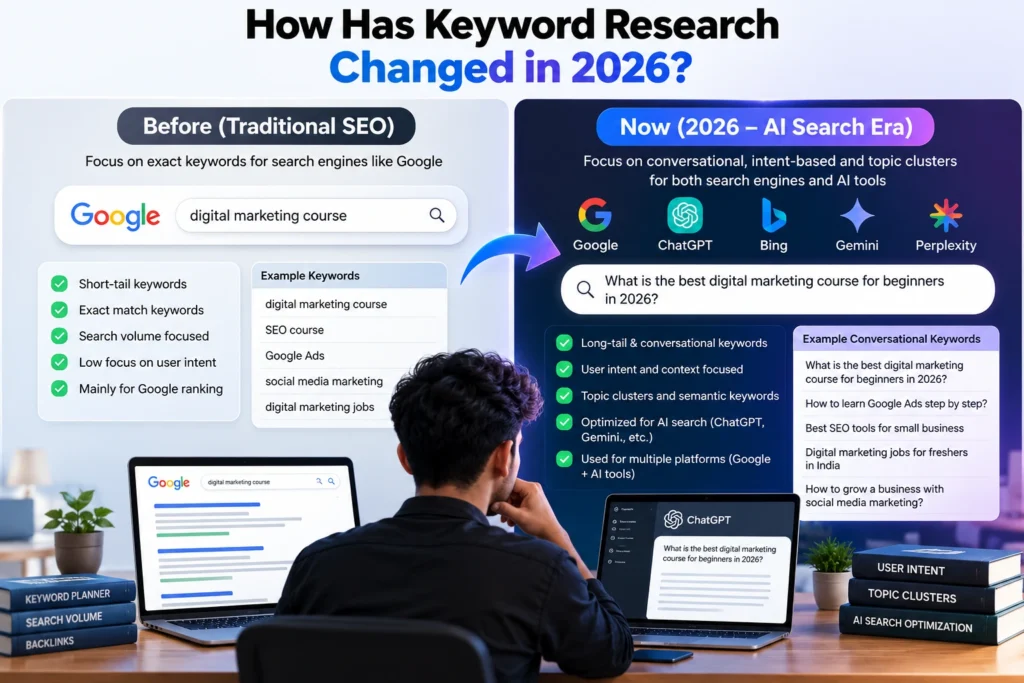
The practical takeaway: AI search platforms answer questions rather than matching a keyword phrase, so the content structure — clear headings, direct answers, and named entities — has become as important as the keyword itself.
How to Find the Best Keywords for SEO in 2026
Follow this sequence rather than jumping straight to a keyword tool:
- Start with a seed topic. Something your audience genuinely searches for, not a phrase you assume they use.
- Expand it with a research tool. Google Keyword Planner, Ahrefs, Semrush, or Ubersuggest will show related terms and estimated volume.
- Group by intent. Sort results into informational, commercial, transactional, and navigational buckets.
- Check the “People Also Ask” and related search boxes. These reveal the actual questions behind a keyword.
- Look at what’s already ranking. If AI Overviews or featured snippets already fully answer the query, weigh whether it’s worth targeting for organic clicks.
- Map keywords into a topic cluster, with one pillar page and several supporting pages.
What Factors Should You Consider When Doing Keyword Research?
Not every keyword with volume is worth targeting. Weigh these factors before committing:
- Search intent — does the keyword match what your page or product actually offers?
- Competition level — can a smaller site realistically compete for this term?
- Business value — will ranking for this keyword bring people close to a decision, not just information?
- Zero-click risk — is this a query AI Overviews are likely to fully answer on the results page?
- Seasonality and trend direction — is interest rising, flat, or declining?
- Content fit — do you have (or can you create) genuinely useful content for this topic?
How to Optimize Your Content for Keywords in 2026
Once you’ve chosen your keywords, optimization looks less like insertion and more like structure:
- Use the primary keyword naturally in the H1, introduction, at least one subheading, and the conclusion
- Answer the core question in the first 1–3 sentences of any section that targets a question-based query
- Use related terms and synonyms instead of repeating the exact phrase
- Structure content with clear headings, short paragraphs, and lists so both readers and AI systems can extract information easily
- Back up claims with facts you can verify, not assumptions
- Avoid stuffing — write for the person reading, not the algorithm scanning
Why Keyword Research Matters for SEO and AI Search in 2026
Business owners and marketing students both need to understand this: ranking on Google is no longer the only goal. Getting cited inside an AI-generated answer is now its own form of visibility, even without a click. Content that is well-structured, factually accurate, and organized around clear topics has a better chance of being referenced by AI search tools, which is why keyword research today has to serve two audiences — human readers and AI systems reading on their behalf.
Conclusion
Keyword research in 2026 hasn’t disappeared — it has matured. The old approach of chasing exact-match phrases and volume numbers has given way to a strategy built on intent, topic clusters, and content that AI search tools can actually understand and cite. Whether you’re a student learning SEO, a freelancer building client campaigns, or a business owner managing your own brand, the practical move is the same: research topics and questions, not just keywords, and structure your content so it answers those questions clearly. Start by picking one topic cluster this week and mapping the questions your audience is actually asking.