
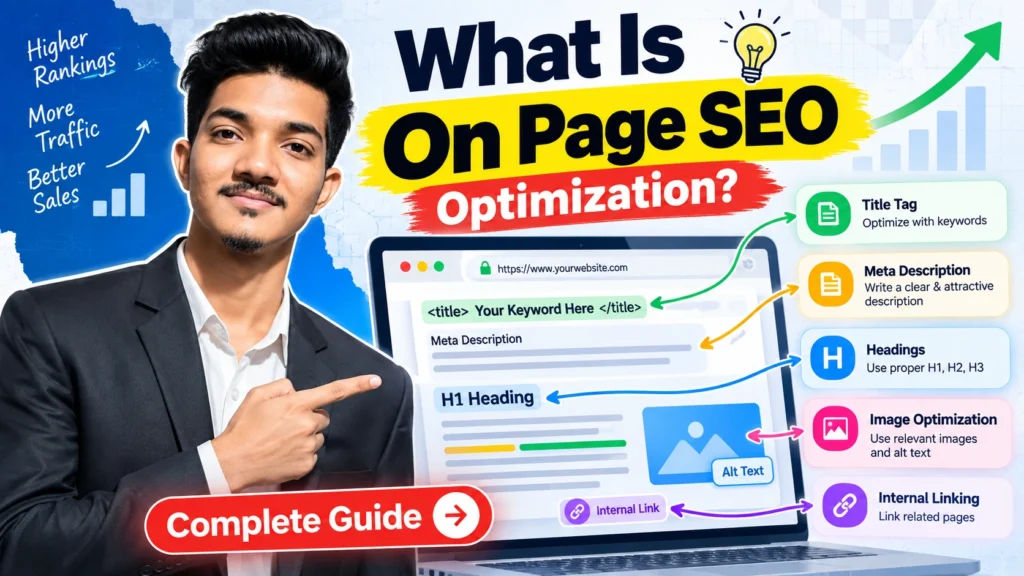
Every search on Google triggers algorithms designed to deliver the most relevant, high-quality answer to a user’s prompt. On-page SEO optimization is the practice of adjusting the content, structure, and HTML source code of individual web pages so search engines can accurately read, index, and rank them.
Mastering page-level adjustments is fundamental to digital visibility. Whether running an e-commerce site, managing a brand, or studying performance marketing, optimizing these elements ensures search bots and human visitors quickly grasp your page’s exact focus.
Table of Contents
What Is On-Page SEO ?
On-page SEO (sometimes called on-site SEO) refers to configuring the visual content and underlying HTML code of a specific page to make it legible to search engines and visitors. Unlike off-page signals that happen elsewhere across the web, every detail on your page falls directly under your control.
Search engines do not read web pages the way humans do; they parse code, measure page speeds, scan structural headings, and evaluate semantic relationships between words. On-page optimization aligns your technical markup and written copy with those automated parameters.
Why On-Page SEO Is Important
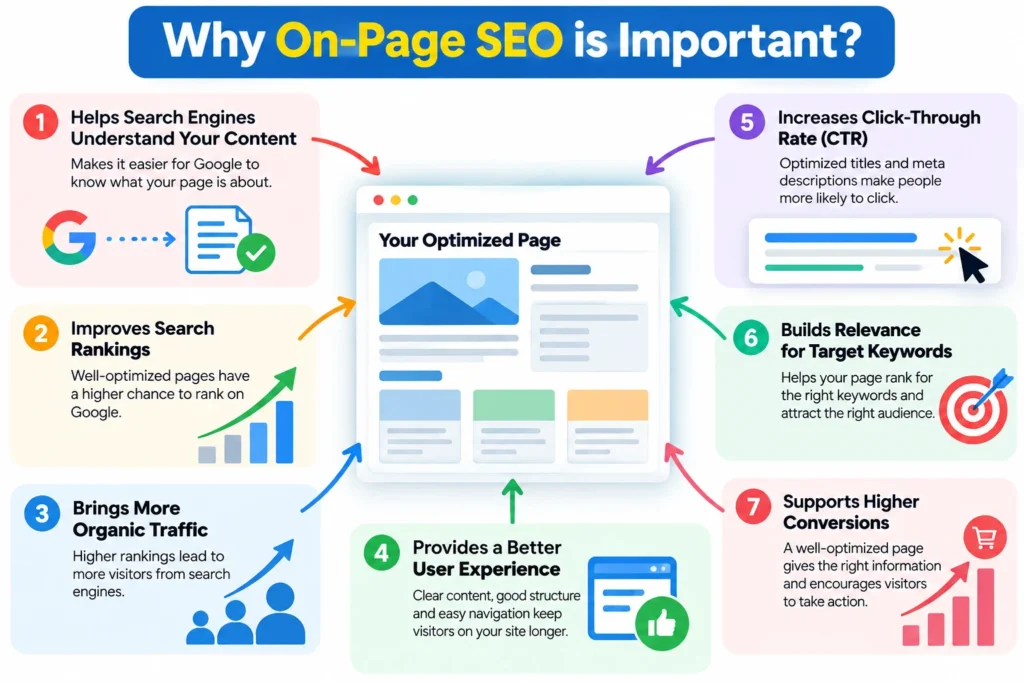
Search engines process billions of queries daily. On-page SEO helps search engines connect a searcher’s query with the precise page that resolves their search intent. Without proper page-level optimization, algorithms may misinterpret your topic or fail to index your most valuable insights.
- Improves Search Relevance: Clear meta tags and headings signal the exact scope of your page to crawling bots.
- Enhances User Experience (UX): Fast load times, readable typography, and logical heading hierarchies lower bounce rates and encourage interaction.
- Maximizes AI & Answer Engine Visibility: Structured markup and direct text answers help Generative Engine Optimization (GEO) platforms extract and cite your insights directly.
- Drives Organic Conversions: Aligning intent with structured calls-to-action converts cold search traffic into engaged readers or customers.
How to Do On-Page SEO: An Easy 11-Step Checklist
Implementing effective page optimization requires a repeatable workflow. Use this 11-step framework whenever publishing or refreshing web content.
1.Use Your Main Keywords in the Right Places:
Place your primary keyword within the first 100 words of body copy, the H1 tag, URL, title tag, and naturally inside a few subheadings (H2s). Avoid artificial keyword density; prioritize semantic variations and natural language context.
2.Write Accurate Title Tags:
Keep meta title tags between 50 and 60 characters to prevent truncation in search result displays. Front-load your core topic, keep the wording clear, and include your brand name where space permits.
3.Optimize URL Slugs:
Craft concise, lowercase URL slugs separated by hyphens (e.g., /on-page-seo-guide/). Exclude redundant filler words like “a,” “the,” or “and” to maintain short, descriptive addresses.
4.Write Accurate Meta Descriptions:
Draft a compelling meta description between 150 and 160 characters. Clearly state what the reader gains from visiting, naturally incorporate your primary term, and include an explicit call to action.
5.Structure Your Content with Headings:
Organize topics logically using a single H1 for the title, followed by H2s for primary sub-topics and H3s for supporting sub-points. A clean heading hierarchy helps both readers and crawlers parse document structure easily.
6.Create Human-Written & Helpful Content:
Focus on Google’s E-E-A-T guidelines (Experience, Expertise, Authoritativeness, Trustworthiness). Address search intent comprehensively, explain technical terms simply, and provide original insights, actionable examples, or data points.
7.Add Internal Links:
Link out to relevant supporting pages within your own domain using descriptive anchor text. Internal links pass link equity (PageRank) across your site structure and assist crawlers in discovering new URLs.
8.Add External Links to Credible Sources:
Reference authoritative external sources—such as official documentation, government datasets, or primary research publications—when presenting figures or standard definitions. Citing trusted authorities reinforces information accuracy.
9.Descriptive Image File Names and Alt Text:
Name raw image files descriptively before uploading (e.g., on-page-seo-checklist.png instead of IMG_001.png). Write clear image alt text that describes the actual graphic for visually impaired users and image search crawlers.
10.Optimize Your Page Speed:
Compress image sizes using modern formats (WebP/AVIF), minimize render-blocking JavaScript, and leverage browser caching. Fast loading speeds form a critical component of Google’s Core Web Vitals performance benchmarks.
11.Add Schema Markup:
Implement structured data markup using JSON-LD formatting (e.g., Article, FAQPage, or Product schema). Schema translates unstructured HTML into explicit data entities that help search engines generate rich snippets in search results.
Difference Between On-Page and Off-Page SEO
Search engine optimization splits into distinct operational pillars. The primary distinction comes down to direct page control versus external validation.
| Factor | On-Page SEO | Off-Page SEO |
| Location / Scope | Directly on the web page and in its HTML source code. | Across third-party websites and external web platforms. |
| Primary Goal | Communicate page relevance, quality, and structure to search engines and users. | Build site authority, trust, and reputation across the web ecosystem. |
| Key Elements | Title tags, headers, URL slugs, image alt text, content quality, page speed, and internal links. | Backlinks, brand mentions, digital PR campaigns, guest posting, and social signals. |
| Level of Control | 100% direct control over implementation and edits. | Indirect influence through outreach, relationships, and content amplification. |
Conclusion
On-page SEO optimization comes down to making each page clear, useful, and easy to process for both people and machines. Work through the checklist above, starting with your title, headings, and content quality, since those usually have the biggest impact.
Pick one key page on your website today and audit it against the 11-step checklist provided above to uncover immediate optimization opportunities.