

How to Start Social Media Marketing in 2026?
Social media marketing is the practice of using platforms like Instagram, TikTok, LinkedIn, and YouTube to promote a brand, build an audience, and drive real business results. In 2026, it matters more than ever because people now discover products on social apps before they ever open a search engine. If you’re wondering how to start social media marketing in 2026, this guide walks you through it step by step — from picking the right platform to building a strategy, creating content, and tracking what actually works.
You don’t need a big budget or a marketing degree to get started. You need a plan, some consistency, and the right tools. That’s exactly what this guide gives you.
Table of Contents
What Are Social Media Marketing?
Social media marketing (SMM) is the process of creating and sharing content on social platforms to achieve specific business goals — brand awareness, website traffic, leads, sales, or community loyalty. It includes organic posting, paid advertising, influencer partnerships, and community engagement (replying to comments, DMs, and mentions).
Think of it less as “posting stuff online” and more as running a small media channel for your brand. Every post, story, or video is a piece of content that either builds trust with your audience or gets scrolled past. The goal is to make sure it’s the former.
why is social media marketing important
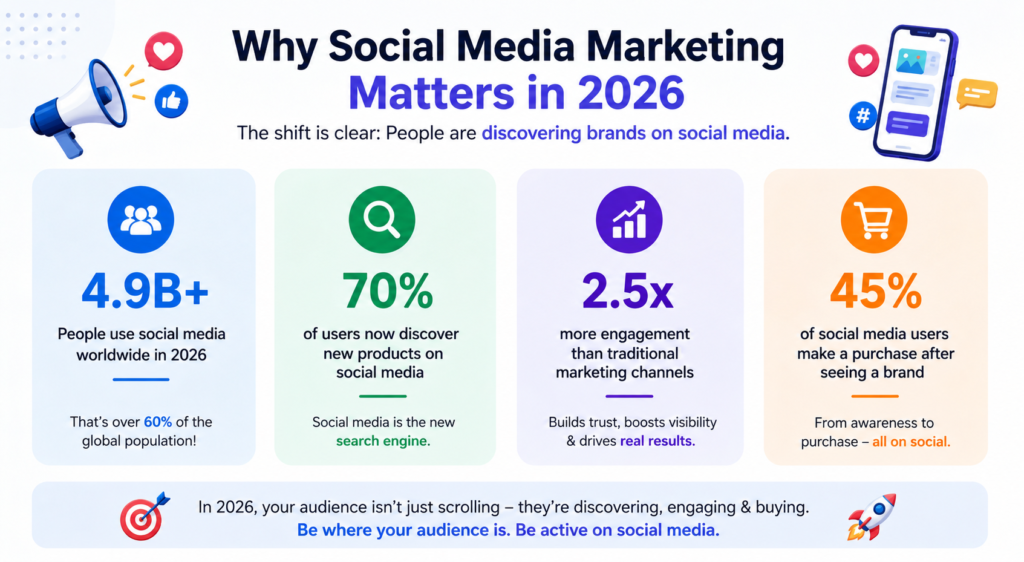
Social platforms have quietly become search engines. Younger audiences increasingly research products on TikTok and Instagram before typing anything into Google, which means a brand’s social presence now influences buying decisions earlier in the funnel than ever before.
A few reasons this shift matters for you right now:
- Social platforms are where product discovery happens first, especially for shoppers under 35.
- Consumers trust real people and user-generated content far more than polished ads.
- Short-form video continues to dominate attention and ad budgets across nearly every platform.
- Brands that respond quickly to comments and messages build stronger loyalty and repeat business.
- AI tools have made it realistic for a solo creator or small team to run a professional-grade content operation.
In short: if your brand isn’t showing up on social media in 2026, a competitor’s is — and they’re capturing the attention you’re missing.
Benefits Of Social Media Marketing
Before diving into the how-to, it helps to know what you’re actually working toward. Here’s what a consistent social media marketing effort can realistically deliver:
- Brand awareness — more people recognize your name, logo, and voice.
- Direct customer relationships — comments and DMs create two-way conversations you can’t get from a billboard.
- Lower-cost advertising — paid social typically costs less per lead than traditional media like TV or print.
- Faster feedback loops — you learn what your audience wants within days, not months.
- Improved SEO signals — active social profiles support brand searches and link building, complementing your Beginner SEO Guide.
- Sales and lead generation — through shoppable posts, link-in-bio tools, and direct messaging.
List Of Social Media Apps
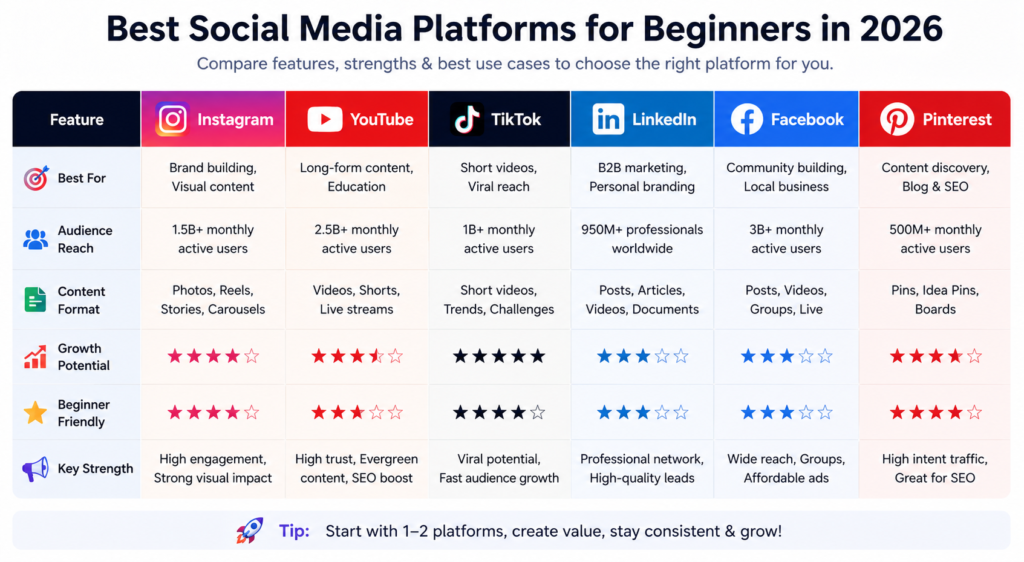
There isn’t one “best” platform for everyone. The right one depends on your audience, your content style, and your goals. Here’s a snapshot comparison to help you decide.
| Platform | Best For | Content Style | Difficulty for Beginners | Ideal Audience |
| Visual brands, e-commerce, creators | Reels, carousels, stories | Medium | 18–34, broad consumer | |
| TikTok | Fast growth, brand awareness | Short-form video | Medium-High | 16–34, trend-driven |
| Local business, community groups | Mixed content, groups, ads | Low | 25–54, broad reach | |
| B2B, personal branding, hiring | Text posts, articles, video | Medium | 25–44, professionals | |
| YouTube | Long-term authority, tutorials | Long-form + Shorts | High (time investment) | All ages, intent-driven |
| Home, fashion, food, DIY niches | Static pins, idea pins | Low | 25–44, mostly women | |
| X (Twitter) | News, tech, real-time commentary | Short text, threads | Medium | 25–44, niche communities |
| Threads | Community-driven, text-first | Casual text posts | Low | 18–34, early adopters |
How to choose the right social media platform for your business?
Ask yourself three questions before you commit:
- Where does my audience already spend time? Don’t guess — check competitor followings or run a quick poll.
- What content can I realistically create? If you hate being on camera, TikTok will feel like a grind. Pinterest or LinkedIn text posts might suit you better.
- What’s my goal — awareness or conversions? Instagram and TikTok are strong for awareness; LinkedIn and Pinterest often convert better for specific niches like B2B services or product discovery.
A common beginner mistake is trying to be everywhere at once. Pick one primary platform and one secondary platform. Master those before expanding.
How to Start Social Media Marketing in 2026: Step-by-Step Beginner Guide?
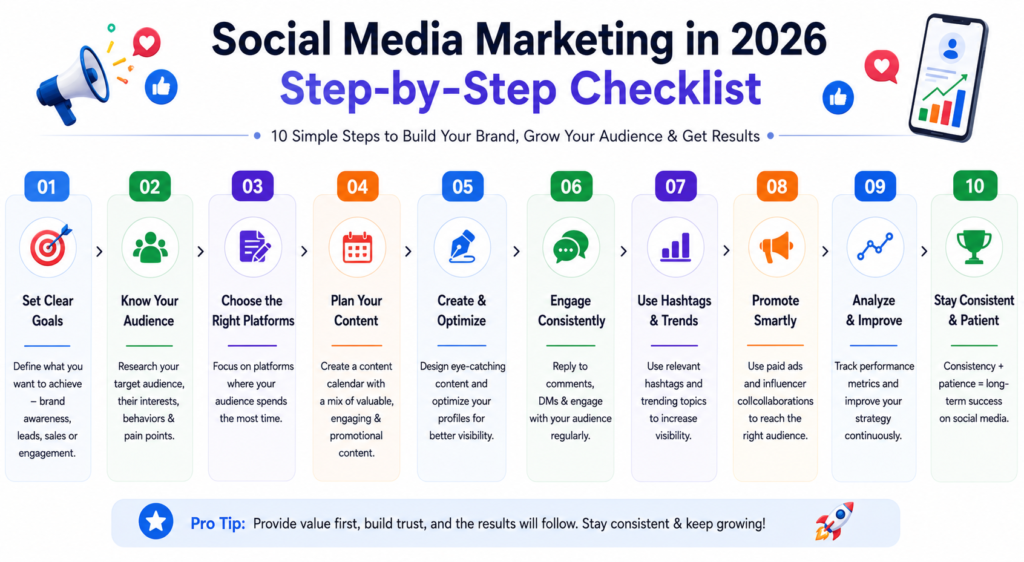
Here’s the exact sequence to follow when you’re starting from zero.
Step 1: Define Your Goals
Vague goals like “get more followers” won’t guide your decisions. Set specific, measurable goals instead:
- Grow email list by 500 subscribers in 90 days via social traffic
- Reach 10,000 monthly profile visits within 6 months
- Generate 50 qualified leads per month from LinkedIn
Step 2: Research Your Audience
Build a simple audience persona: age range, main problems, where they hang out online, and what kind of content stops their scroll. Use platform analytics, customer surveys, and comment sections on competitor posts to gather this.
Step 3: Analyze Your Competitors
Pick 3–5 competitors or similar creators. Note:
- Posting frequency
- Content formats that get the most engagement
- Tone of voice
- Gaps you can fill (topics they ignore, questions they don’t answer)
Step 4: Choose Your Platforms
Use the comparison table above. Commit to one primary and one secondary platform for the first 90 days.
Step 5: Build Your Content Strategy
Your strategy should answer: What will you post, how often, and why. A simple framework is the 80/20 rule — 80% helpful, entertaining, or educational content, 20% direct promotion.
Step 6: Create a Content Calendar
Plan content at least two weeks ahead. This removes daily guesswork and keeps your posting consistent, which matters more to algorithms than sporadic bursts of high effort.
Step 7: Set Up Your Profiles Properly
Optimize your bio, profile photo, link-in-bio, and pinned content before you start posting heavily. First impressions on a profile visit matter as much as the content itself.
Step 8: Start Posting Consistently
Consistency beats perfection. A realistic starting cadence:
- Instagram/TikTok: 3–5 times per week
- LinkedIn: 3–4 times per week
- Facebook: 3–5 times per week
- Pinterest: 5–10 pins per week (can be batch-scheduled)
Step 9: Engage With Your Community
Reply to every comment and DM in the first few weeks. Brands that respond quickly and personally build noticeably stronger loyalty — audiences increasingly expect fast replies and often say they’re less likely to buy from brands that ignore them.
Step 10: Track, Learn, and Adjust
Review analytics weekly. Double down on what performs; drop what doesn’t. Social media marketing is a loop, not a one-time setup.
Strategy For Social Media Marketing
A strategy document doesn’t need to be complicated. At minimum, define:
- Mission statement — why you’re on social media, in one sentence
- Target audience — who you’re speaking to
- Content pillars — 3–5 recurring themes (e.g., education, behind-the-scenes, testimonials, product tips, industry news)
- Platform priorities — where you’ll show up and how often
- Success metrics — what “working” looks like
Template For Social Media Calendar
Use a simple spreadsheet or a free tool like Google Sheets, Notion, or Trello to map content by week. Include the platform, format, caption idea, hashtag set, and publish date. This single habit eliminates most of the stress beginners feel about “what do I post today.”
Personal Branding vs. Business Branding
| Factor | Personal Branding | Business Branding |
| Voice | First-person, personal opinions | Company voice, consistent tone |
| Trust Building | Faster — audiences connect with people | Slower — built through consistency |
| Content Style | Behind-the-scenes, opinions, lessons learned | Product updates, testimonials, offers |
| Best Platforms | LinkedIn, Instagram, TikTok, X | Facebook, Instagram, LinkedIn, YouTube |
| Long-Term Value | Portable — follows you, not the company | Tied to the brand, more scalable |
If you’re a freelancer or consultant, personal branding usually outperforms a faceless business page. If you’re running a product-based business, a mix of both — a strong founder presence plus a consistent brand account — tends to work best.
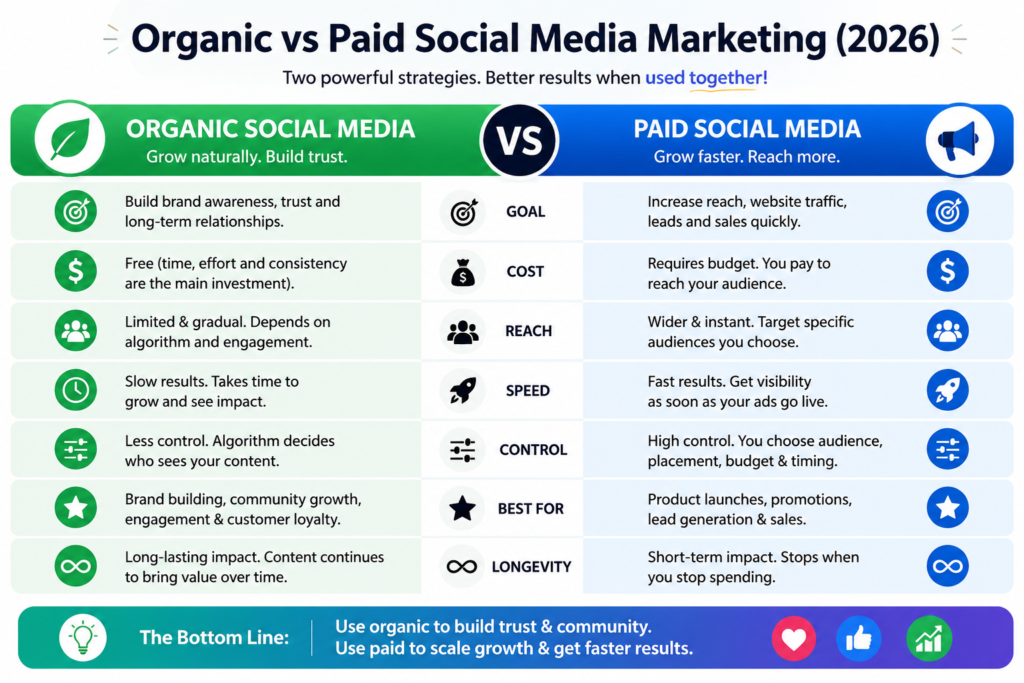
Organic Growth vs. Paid Marketing
| Factor | Organic Growth | Paid Marketing |
| Cost | Free (time investment) | Requires ad budget |
| Speed of Results | Slower, compounding | Faster, immediate reach |
| Trust Level | Higher — feels authentic | Lower initially, builds with retargeting |
| Scalability | Limited by algorithm reach | Highly scalable with budget |
| Best For | Long-term brand building | Launches, promotions, lead generation |
Most beginners should start organic to learn what content resonates, then layer in a small paid budget (even $5–$10/day) to boost proven winners once they see traction. Global ad spend on social media is projected to be a major share of total digital ad investment in 2026, but that doesn’t mean you need a big budget to start — it means paid social is a viable, scalable channel once your organic content is validated.
Platform-Specific Marketing Guides
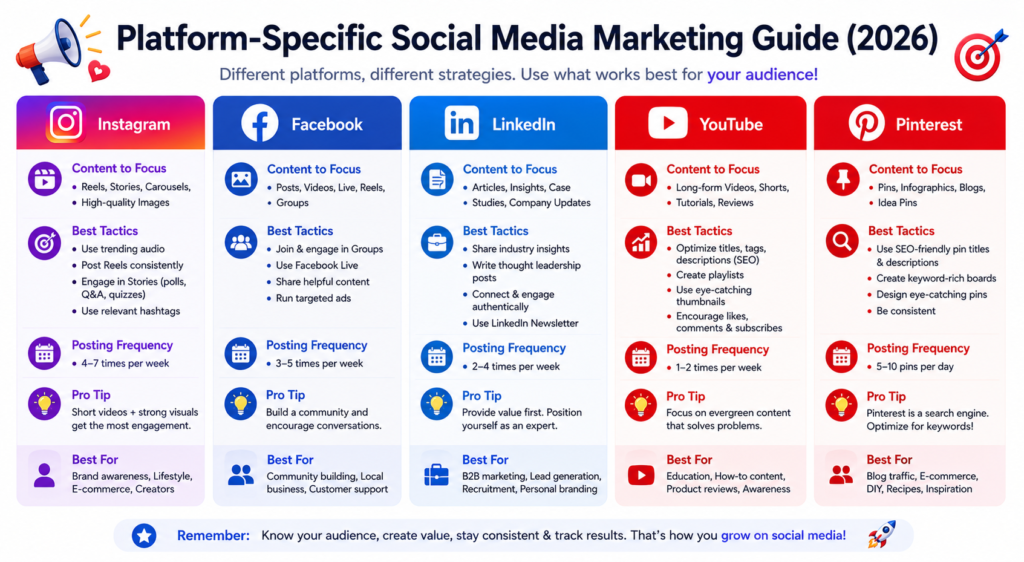
Marketing On Instagram
Instagram remains one of the most-used platforms by marketers, largely thanks to Reels and shopping features. Focus on:
- Reels for reach, carousels for saves and shares
- A consistent visual style in your grid
- Strong hooks in the first 2 seconds of video
Social Media Facebook Marketing
Facebook still holds one of the largest user bases globally and works especially well for local businesses and community-driven groups. Use Facebook Groups to build community alongside your page.
Linkedin For Marketing
LinkedIn has grown significantly as a marketing channel, especially for B2B brands and personal branding. Post practical lessons, case studies, and career insights. Native documents (carousel PDFs) and short video both perform well.
Youtube For Marketing
YouTube remains one of the largest platforms by monthly active users and rewards depth. Start with YouTube Shorts to build initial traction, then expand into long-form tutorials or vlogs once you understand what topics your audience wants.
Pinterest Marketing for Beginners
Pinterest works like a visual search engine rather than a social feed. It’s ideal for niches like home decor, recipes, fashion, and DIY, where pins can drive traffic for months or years after posting.
X (Twitter) Marketing for Beginners
X works best for real-time commentary, industry news, and building a personal voice through threads. It rewards frequent, punchy posting more than polished visuals.
Threads Marketing for Beginners
Threads is text-first and community-driven. It’s a lower-pressure environment to test messaging and build a following through conversation rather than production value.
Social Media Marketing Tools
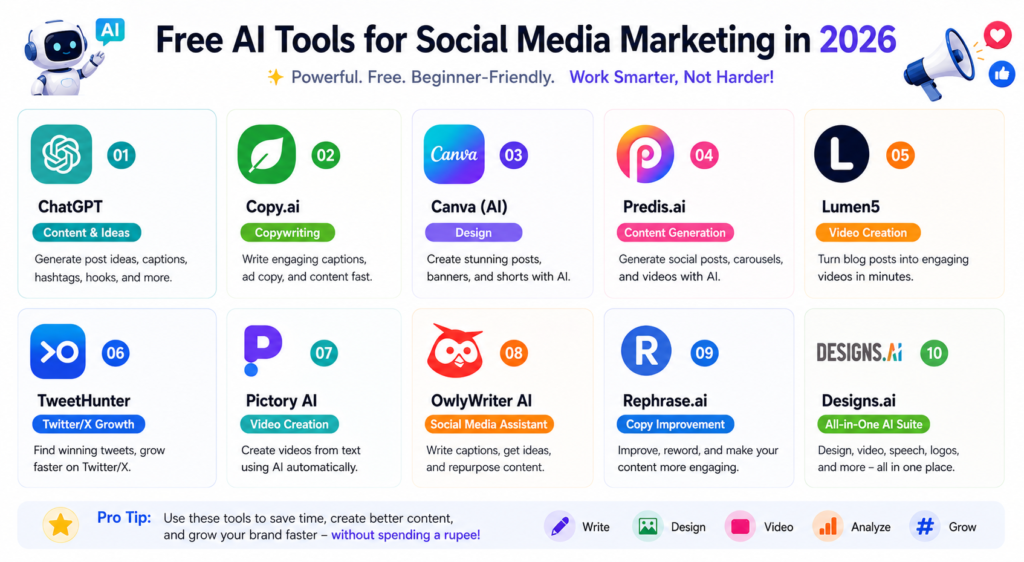
AI is now a default part of the social media workflow — used for captions, editing, scheduling, and performance analysis. Brands using AI-powered personalization in their campaigns tend to see meaningfully higher engagement. That said, audiences are increasingly wary of content that feels fully AI-generated, especially visuals, so use AI to speed up your workflow, not to replace your authentic voice.
Free Tools for Beginners
- Canva — graphic design and video templates
- CapCut — mobile video editing for Reels, TikTok, Shorts
- Google Trends — spotting trending topics
- Meta Business Suite — free scheduling and analytics for Facebook/Instagram
- Buffer (free tier) — basic cross-platform scheduling
- ChatGPT or Claude — caption drafts, content ideas, repurposing
Paid Tools Worth Considering Later
- Sprout Social or Hootsuite for advanced scheduling and reporting
- Later for visual content planning
- Brandwatch or Talkwalker for social listening at scale
Analytics, KPIs, and ROI: How to Know It’s Working
Tracking the right numbers keeps you from guessing. Focus on a small set of KPIs rather than every metric your dashboard offers.
| Metric | What It Tells You | Why It Matters |
| Engagement Rate | How much your audience interacts with content | Signals content relevance |
| Reach/Impressions | How many people see your content | Shows visibility and algorithm favor |
| Follower Growth Rate | How fast your audience is growing | Long-term momentum indicator |
| Click-Through Rate | How many people click your link | Traffic and lead generation health |
| Conversion Rate | How many clicks turn into leads/sales | Direct business impact |
| Cost Per Result (paid) | Efficiency of ad spend | Budget optimization |
To calculate a simple ROI, compare the value generated (sales, leads, saved advertising cost) against your total time and money invested. Even a rough estimate is better than tracking nothing.
Common Mistakes Beginners Make in Social Media Marketing
- Trying to post on every platform at once instead of mastering one
- Posting inconsistently, then giving up after a few weeks of “no results”
- Focusing only on follower count instead of engagement and conversions
- Ignoring comments and DMs
- Copying competitors instead of finding a distinct angle
- Never reviewing analytics to see what’s actually working
- Using generic, overly polished AI content that feels inauthentic
Expert Tips for Faster Growth
- Repurpose one piece of content into 4–5 formats (a blog post becomes a carousel, a Reel, a thread, and a newsletter snippet)
- Study your top 3 performing posts every month and create more like them
- Build a simple content calendar; the Content Marketing Guide covers this in more depth
- Collaborate with micro-creators in your niche instead of chasing celebrity influencers
- Show your face and voice — human-led content consistently outperforms faceless, generic posts
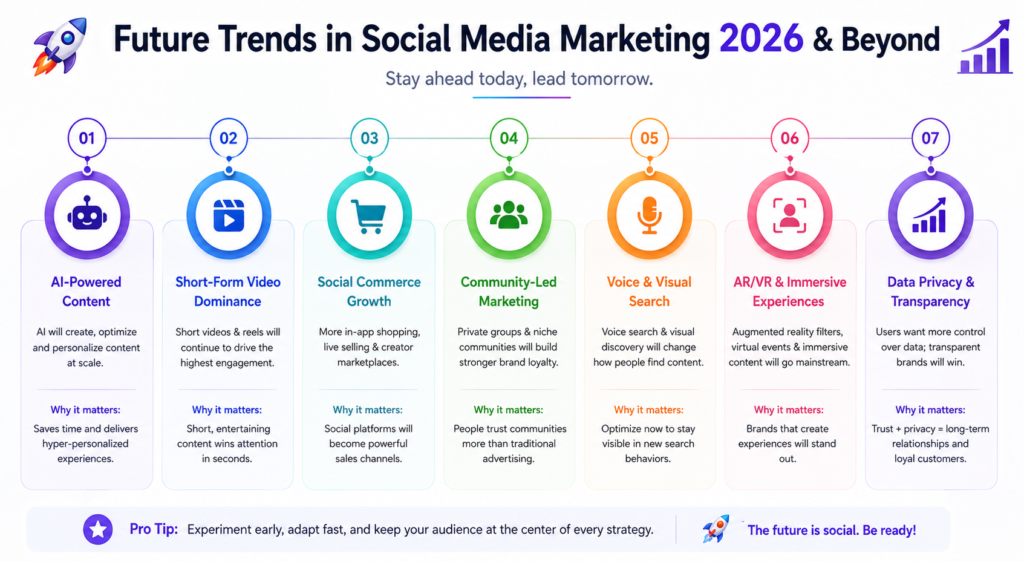
Future Trends in Social Media Marketing
- Social search keeps expanding — TikTok, Instagram, and YouTube already drive a majority of product discovery for younger audiences, ahead of traditional search.
- AI-assisted, human-led content wins — full automation is losing trust; strategic AI use paired with a real voice is winning.
- Community and UGC over polish — user-generated content is trusted far more than traditional brand advertising, so incentivizing real customer content will keep paying off.
- Social commerce keeps growing — in-app shopping and creator-led storefronts are becoming a standard purchase path, not a novelty.
- Faster response times become a ranking factor for trust — audiences increasingly expect brands to reply to comments and DMs quickly.
Latest Social Media Marketing Statistics (2026)
- Global social media users have crossed roughly 5.6 billion people, making up a clear majority of the online population (National University).
- TikTok is the platform most marketers plan to invest in the most for 2026, with short-form video as the top content format overall (HubSpot State of Marketing Report, 2026).
- Instagram remains the most-used platform among marketers, cited by around 70% of respondents, narrowly ahead of Facebook (HubSpot State of Marketing Report, 2026).
- Social commerce has grown into a multi-trillion-dollar global market, driven by in-app storefronts and creator-led shopping content (Goat Agency, 2026).
- Platforms like TikTok, Instagram, and YouTube now collectively drive the majority of product discovery, ahead of traditional search engines (Sprout Social, 2026).
- Roughly three-quarters of consumers say they’ll switch to a competitor if a brand doesn’t respond to them on social media (Sprout Social, 2026).
- The vast majority of consumers say they trust word-of-mouth and user-generated content more than traditional brand advertising (National University, 2026).
Case Study Example: A Small Business Starting From Zero
Imagine a local bakery with zero social presence. In month one, they pick Instagram as their primary platform and post 4 times a week — mostly short Reels of the baking process and a few customer testimonials. By month three, using a simple content calendar and replying to every comment personally, they’ve grown from 0 to 1,200 followers and started seeing walk-in customers mention “I saw your Reels.” That’s the real-world pattern behind most social media marketing success stories: consistency, a clear niche, and genuine engagement — not a viral fluke.
Best Practices Checklist
- Pick one primary and one secondary platform
- Write a one-page content strategy with clear goals
- Build a two-week content calendar before you post
- Optimize your profile bio and link-in-bio
- Post consistently (3–5 times per week minimum)
- Reply to every comment and DM for the first 90 days
- Review analytics weekly and adjust
- Test one small paid boost once you find a winning post
- Repurpose content across formats and platforms
- Stay authentic — don’t over-rely on AI-generated visuals
Final Action Plan: Your First 30 Days
- Week 1: Define goals, research audience, pick your platform(s), set up profiles
- Week 2: Build your content pillars and a two-week content calendar
- Week 3: Post consistently, engage daily, track early metrics
- Week 4: Review what worked, adjust your calendar, plan month two
Conclusion
Learning how to start social media marketing in 2026 comes down to a few fundamentals done consistently: choose the right platform for your audience, build a simple strategy around clear goals, plan your content instead of winging it, and show up as a real, responsive voice — not a faceless brand account. Add the right free tools and a little AI-assisted efficiency, and you have everything you need to compete, even with zero budget.
The platforms and trends will keep shifting, but the core approach won’t: know your audience, be consistent, and actually engage with the people who show up. Don’t wait for the “perfect” strategy. Pick your platform, write your first week of content today, and post it. Momentum builds from action, not planning.