
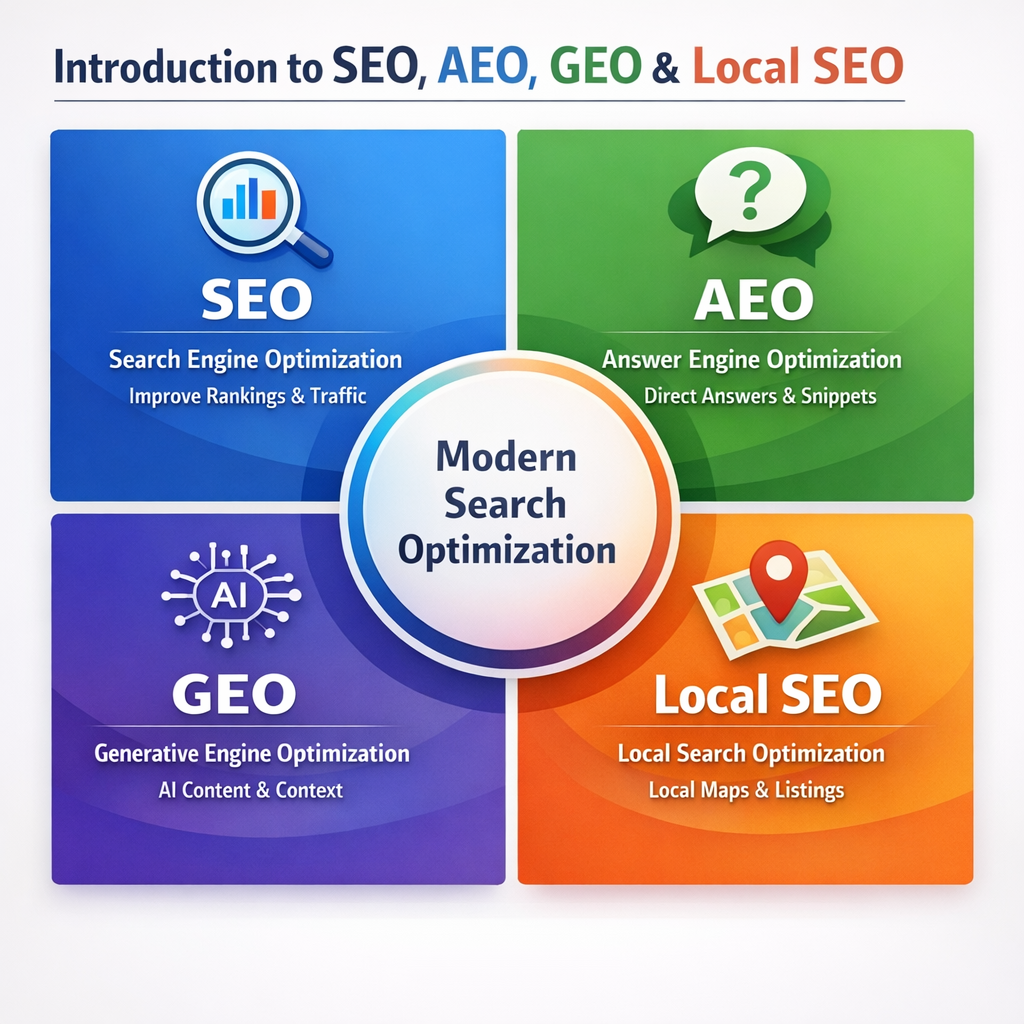
When working on the SEO 2026 Complete Roadmap, it is important to understand that optimizing a website today requires following a clear and structured checklist. In modern search optimization, SEO is no longer limited to traditional techniques. A complete strategy now involves Search Engine Optimization (SEO), Answer Engine Optimization (AEO), and Generative Engine Optimization (GEO).
In addition to these core strategies, Local SEO also plays an important role when targeting location-based searches. By optimizing local elements such as business information, local keywords, and location-specific content, websites can improve visibility in local search results.
From practical experience, whenever you work on optimizing your own website or a client’s website, focusing on SEO, AEO, and GEO together creates a strong foundation for search visibility. When these three areas are implemented properly, a website has a much higher chance of ranking in modern search environments, including traditional search engines and AI-powered search platforms.
Table of Contents
Introduction to SEO, AEO, GEO, Local SEO
Search Engine Optimization (SEO)
Search Engine Optimization (SEO) is the process of optimizing a website so that it can rank higher in search engine results and attract organic traffic. It focuses on improving content quality, website structure, and user experience to help search engines understand and index webpages effectively.
Answer Engine Optimization (AEO)
Answer Engine Optimization (AEO) is the practice of structuring content so that search engines and AI systems can easily extract and present direct answers to user queries. It focuses on clear explanations, question-based content, and structured information that can appear in featured snippets, voice search results, and AI answers.
Generative Engine Optimization (GEO)
Generative Engine Optimization (GEO) is the process of optimizing content for AI-powered search engines that generate answers using information from multiple sources. It focuses on creating clear, structured, and context-rich content that AI systems can understand and use when generating responses.
Local SEO
Local SEO is the process of optimizing a website so that it appears in search results for location-based queries. It focuses on improving visibility in local searches by optimizing business information, local keywords, Google Business Profile, and location-specific content to attract nearby customers.
Complete SEO, AEO, GEO, Local SEO Checklist
If you follow these four essential checklists properly, you will have a strong foundation for modern search optimization. By applying these strategies effectively, you can significantly improve the chances of ranking your own website or your client’s website in search results.
Search Engine Optimization Checklist (SEO)
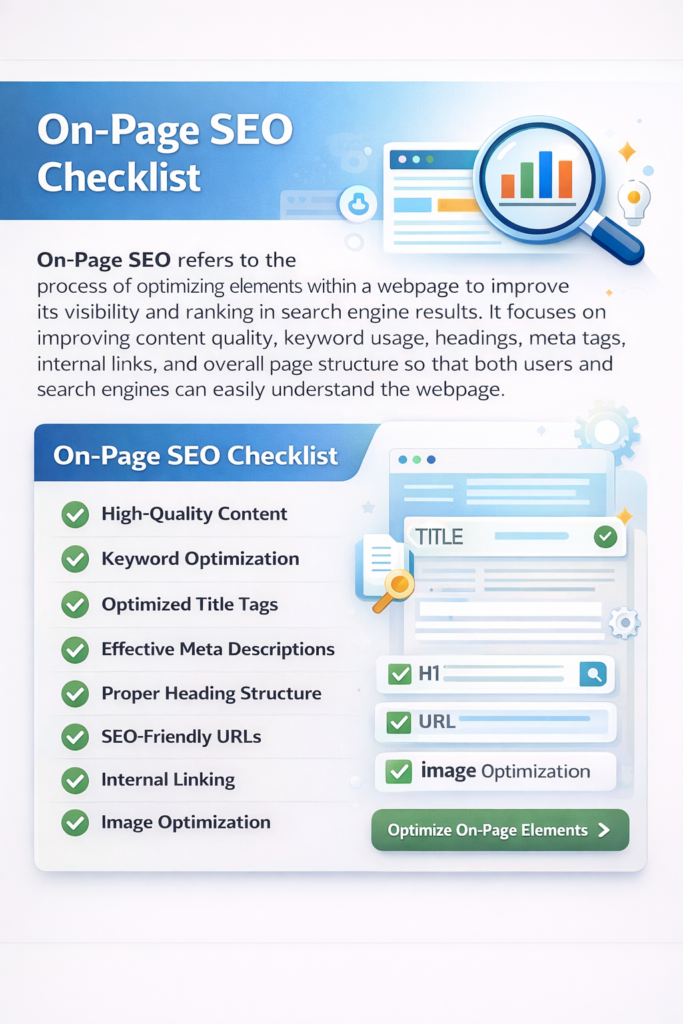
On-Page SEO refers to the process of optimizing elements within a webpage to improve its visibility and ranking in search engine results. It focuses on improving content quality, keyword usage, headings, meta tags, internal links, and overall page structure so that both users and search engines can easily understand the webpage.
| Checklists | Explanation |
| Meta Title | Meta title is the clickable headline that appears in search engine results and helps users understand what the page is about. |
| Meta Description | Meta description is a short summary of a webpage that appears below the title in search results and encourages users to click. |
| URL Structure | URL structure refers to creating clean, short, and readable URLs that clearly describe the page content. |
| Image Optimization | Image optimization means reducing image size, using proper file names, and adding alt text so images load faster and are understood by search engines. |
| Target Keyword Use Naturally | This means using the main keyword naturally within the content without forcing or overusing it. |
| Plagiarism | Plagiarism means copying content from other websites. Good SEO requires unique and original content. |
| Heading Tag Optimization | Heading tags (H1, H2, H3) are used to organize content properly so both users and search engines can understand the page structure. |
| Internal Link and External Link | Internal links connect pages within the same website, while external links point to other trusted websites. |
| Keyword Placement | Keyword placement means adding keywords in important places like title, headings, introduction, and content naturally. |
| Grammar | Proper grammar ensures the content is clear, professional, and easy for users to read and understand. |
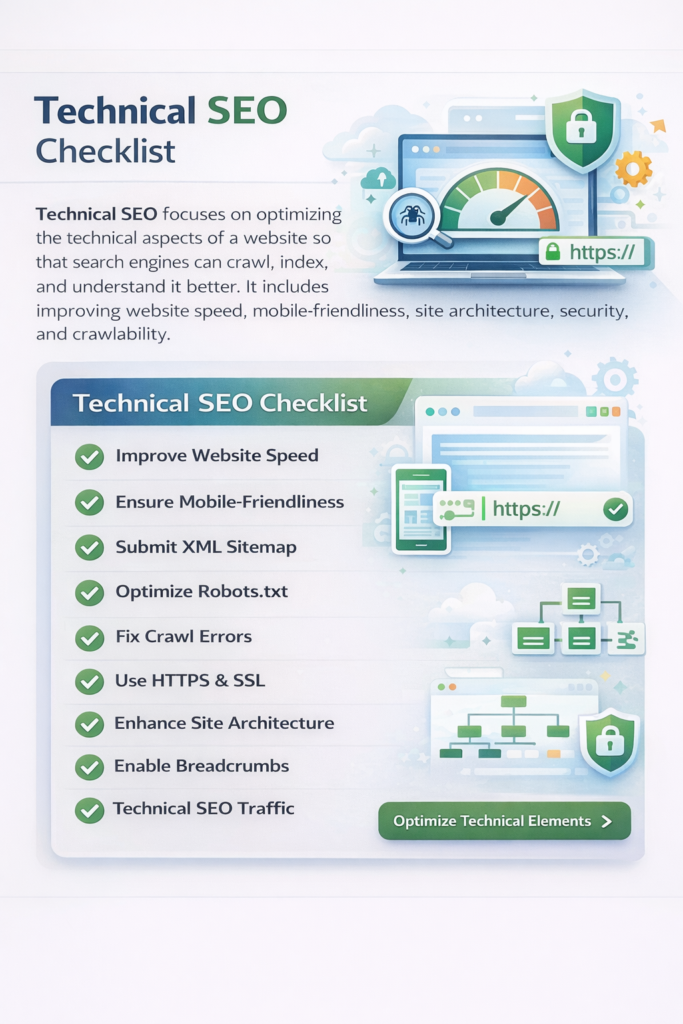
Technical SEO refers to optimizing the technical structure of a website so that search engines can easily crawl, index, and understand the pages. It focuses on elements like website speed, mobile-friendliness, sitemap, robots.txt, HTTPS security, and overall site performance.
| Checklists | Explanation |
| Crawling | Crawling is the process where search engine bots scan and discover pages on your website. |
| Indexing | Indexing means storing your webpage information in the search engine’s database so it can appear in search results. |
| HTTPS/Security | HTTPS ensures that your website is secure and data between the user and server is encrypted. |
| Robot.txt | Robots.txt is a file that tells search engine bots which pages they can crawl and which pages to ignore. |
| Canonical url | A canonical URL tells search engines which version of a page is the main one when duplicate pages exist. |
| Sitemap.xml | Sitemap.xml is a file that lists all important pages of a website to help search engines crawl them easily. |
| Open Graph Protocol | Open Graph protocol controls how your webpage appears when it is shared on social media platforms. |
| Website Speed | Website speed refers to how fast a webpage loads, which affects both user experience and SEO rankings. |
| Mobile Responsiveness | Mobile responsiveness ensures that a website works properly and looks good on mobile devices. |
| Broken Link/404 Error | Broken links or 404 errors occur when a page cannot be found, which can harm user experience and SEO. |
| Schema Tag | Schema markup is structured data that helps search engines better understand the content of a webpage. |
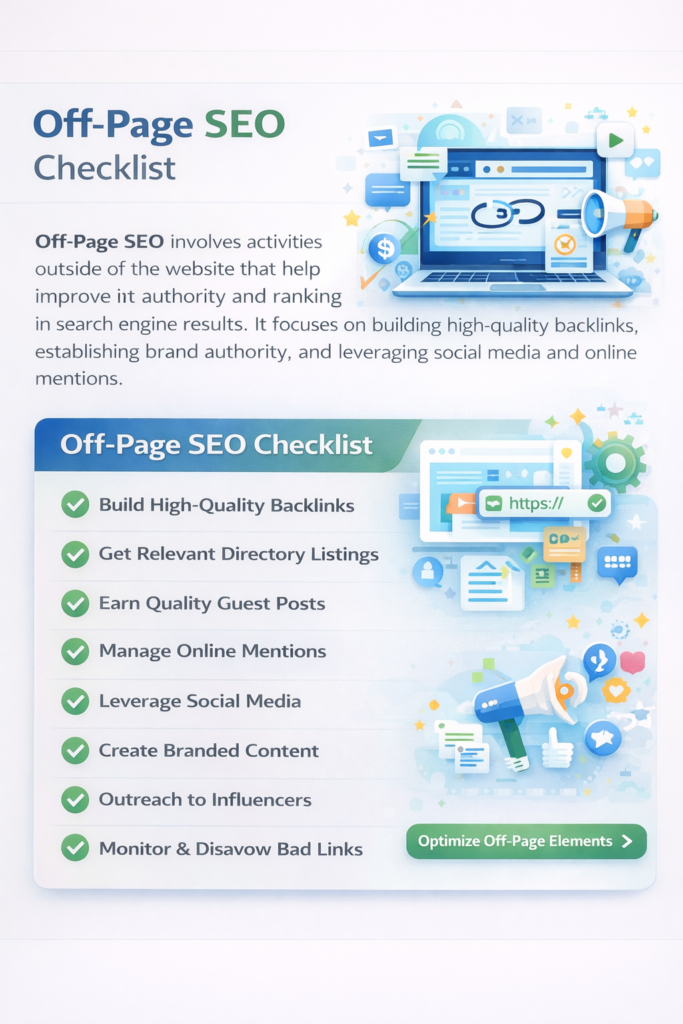
Off-Page SEO refers to activities performed outside of a website to improve its authority and credibility in search engines. It mainly includes building high-quality backlinks, brand mentions, social sharing, and other external signals that help increase the website’s trust and ranking potential.
Key elements of Off-Page SEO:
| Checklists | Explanation |
| Total Backlink | Total backlinks refer to the number of links pointing to your website from other websites. |
| Do Follow Backlink | Do follow backlinks allow search engines to pass authority from one website to another. |
| No Follow Backlink | No follow backlinks tell search engines not to pass link authority but can still bring traffic |
| Anchor Text Backlink | Anchor text backlink is the clickable text used in a hyperlink that points to your website. |
| Domain Authority | Domain authority is a score that predicts how well a website can rank in search engines. |
| Brand Mention | Brand mention happens when your brand name is mentioned on other websites or platforms. |
| Social Sharing | Social sharing refers to sharing website content on social media platforms to increase visibility and traffic. |
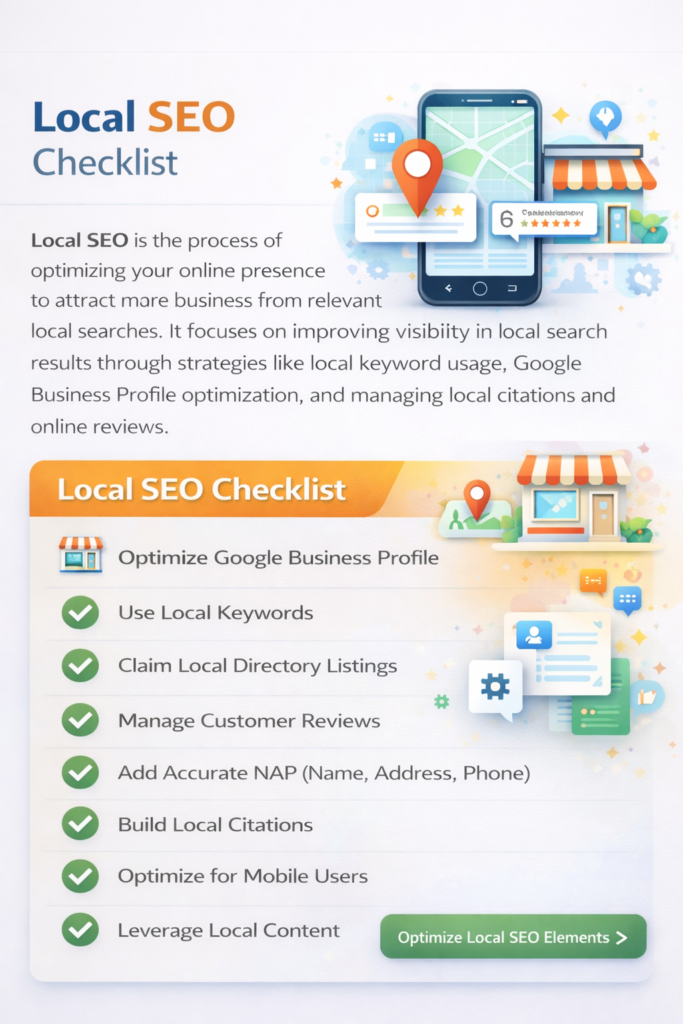
Local SEO:-
Local SEO is the process of optimizing a website or business so it appears in search results for location-based queries. It focuses on improving visibility in local searches by optimizing Google Business Profile, using local keywords, maintaining NAP consistency (Name, Address, Phone Number), and getting local reviews and citations.
Key elements of Local SEO:
| Checklists | Explanation |
| Google Business Profile Optimization | Optimizing your Google Business Profile helps your business appear in local search results and Google Maps. |
| Local Keywords | Local keywords are search terms that include a specific location, such as a city or area. |
| NAP Consistency (Name, Address, Phone Number) | NAP consistency means keeping your business name, address, and phone number the same across all platforms. |
| Local Citations | Local citations are mentions of your business information on online directories and websites. |
| Customer Reviews | Customer reviews help build trust and improve your visibility in local search results. |
| Google Maps Optimization | Google Maps optimization helps your business appear in map results when people search nearby services. |
| Local Backlinks | Local backlinks are links from other local websites that help improve your website’s authority. |
| Location-Based Content | Location-based content includes information related to a specific city or region to target local audiences. |
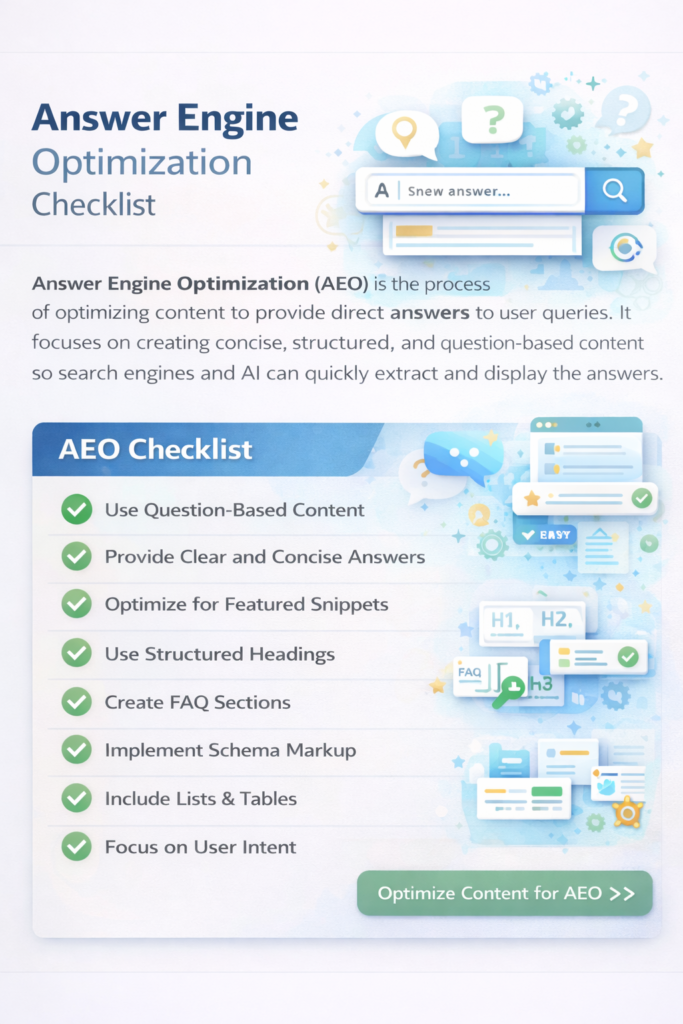
Answer Engine Optimization Checklist (AEO)
Answer Engine Optimization (AEO) is the process of optimizing content so that search engines and AI systems can easily understand and present direct answers to user queries. It focuses on creating clear, structured, and question-based content that can appear in featured snippets, voice search results, and AI-generated answers.
Key elements of AEO:
| Checklist | Explanation |
|---|---|
| Question-Based Content | Create content that directly answers common user questions using headings like what, how, why, and when. |
| Short Answer Paragraph | Provide a clear and concise answer immediately after the question heading to increase the chance of appearing in featured snippets. |
| Featured Snippet Optimization | Structure content in a way that search engines can easily extract and display answers in featured snippets. |
| FAQ Section | Add a frequently asked questions section to help search engines identify clear answers to common queries. |
| Voice Search Optimization | Optimize content for conversational and natural language queries commonly used in voice searches. |
| Conversational Keywords | Use natural, question-based keywords that match how users speak and search online. |
| Structured Headings | Use proper heading structure (H1, H2, H3) so search engines can understand the content hierarchy. |
| Bullet Points and Lists | Use bullet points and numbered lists to present information clearly and improve readability. |
| Table Format Content | Use tables to organize information and make comparisons easier for users and search engines. |
| Schema Markup | Implement structured data like FAQ schema, HowTo schema, and Q&A schema to help search engines understand content better. |
| Clear and Direct Answers | Provide simple and direct explanations that quickly answer user queries. |
| Informational Search Intent | Focus on content that satisfies informational queries where users want to learn something. |
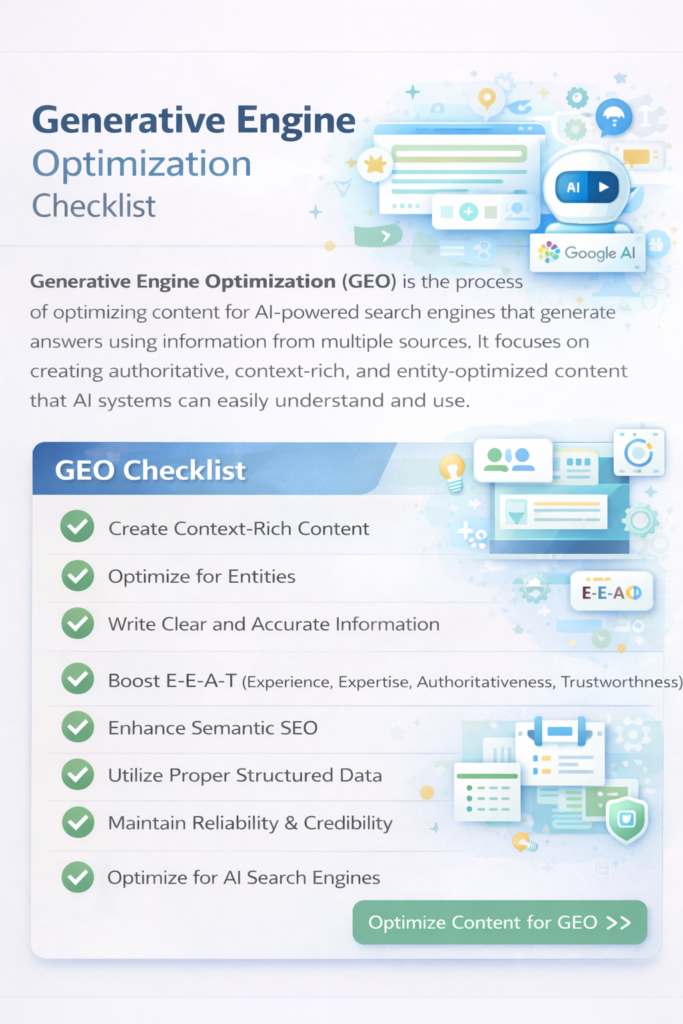
Generative Engine Optimization Checklist (GEO)
Generative Engine Optimization (GEO) is the process of optimizing content so that AI-powered search engines can understand, analyze, and use it when generating answers for users. It focuses on creating clear, structured, and context-rich content that AI systems can easily interpret and include in AI-generated responses.
Key elements of GEO:
| Checklist | Explanation |
|---|---|
| Conversational Content | Write content in natural and conversational language so AI systems can easily understand it. |
| Question-Based Content | Structure content around common user questions to match how people search using AI tools. |
| Clear Topic Explanation | Provide simple and clear explanations so AI search engines can easily identify the main idea. |
| Context-Rich Content | Add detailed context and related information to help AI systems understand the topic deeply. |
| Entity Optimization | Optimize content around clear entities such as topics, concepts, brands, and people. |
| Semantic SEO | Use related keywords and concepts so AI systems understand the full meaning of the topic. |
| Topic Clustering | Organize content using pillar pages and supporting articles to build topical authority. |
| Structured Headings | Use proper heading hierarchy (H1, H2, H3) so AI systems can easily extract information. |
| Lists and Tables | Use bullet lists and tables to structure information clearly for AI interpretation. |
| Fact-Based Content | Provide accurate, reliable, and research-backed information for better AI trust. |
| E-E-A-T Signals | Show experience, expertise, authority, and trustworthiness to improve credibility. |
| Internal Linking | Connect related pages within the website to help AI understand topic relationships. |
Pingback: Top 10 best SEO tools in 2026 - Farhan Khan | SEO Consultant
Thanks for your comment! 😊 Yes, SEMrush is definitely one of the best all-in-one SEO tools. It helps with keyword research, competitor analysis, and overall SEO strategy. Glad you found it useful!
Pingback: EEAT in SEO: What It Is & Why It Matters (2026 Guide) - Farhan Khan | SEO Consultant
Thanks for your comment! Yes, understanding EEAT in SEO is essential to rank higher on Google in 2026.
1. Friendly tone:
Thanks! Absolutely, EEAT in SEO plays a key role in improving rankings and building trust.
2. More engaging:
Great point! EEAT in SEO is crucial for higher rankings and long-term success on Google.
Pingback: The Future of SEO in 2026: A Complete Guide to AI, AEO & GEO
Pingback: Top 10 SEO Trends in 2026
Pingback: Content Writing and SEO Mastery Course | SEO Content Writing
Pingback: Complete SEO Learning Guide For 2026