
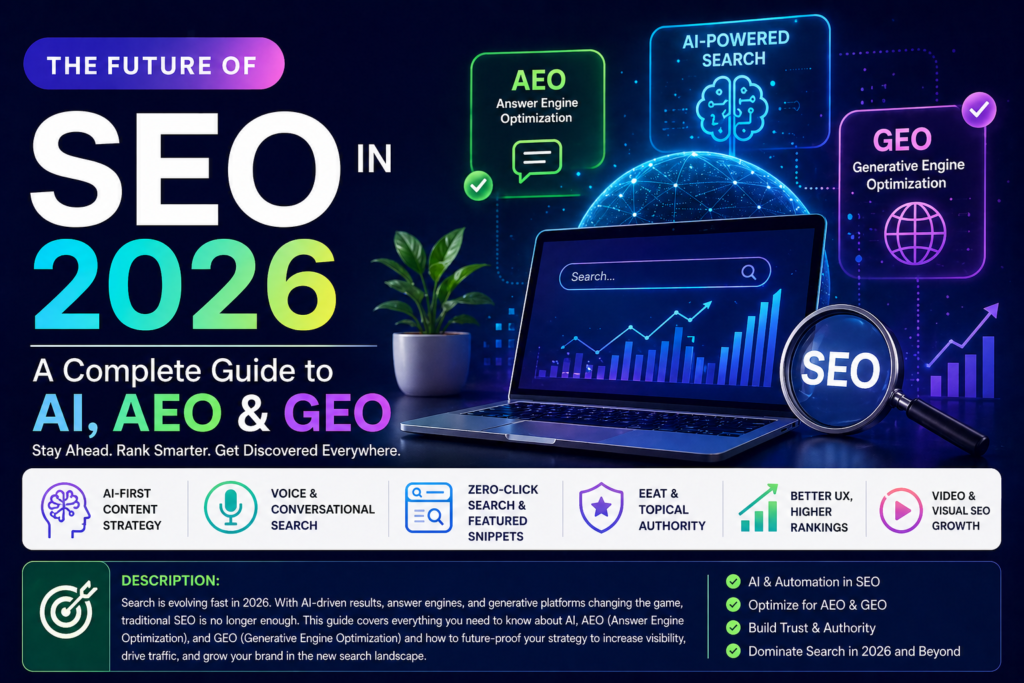
The Future of SEO in 2026: A Complete Guide
Search engine optimization is changing faster than ever, and 2026 is shaping up to be a major turning point. The way people search, the way search engines understand content, and the way websites earn traffic are all being reshaped by artificial intelligence, answer engines, and generative search experiences.
If you want your website to stay visible in 2026, you can no longer rely on old-school SEO alone. You need a strategy that combines SEO, AEO (Answer Engine Optimization), and GEO (Generative Engine Optimization) so your content can perform well across traditional search results, AI-powered answers, and conversational discovery platforms.
In this guide, I will explain what is changing, why it matters, and how to optimize your content for the future. This blog is written in a clear, user-friendly way so it works well for both readers and search engines.
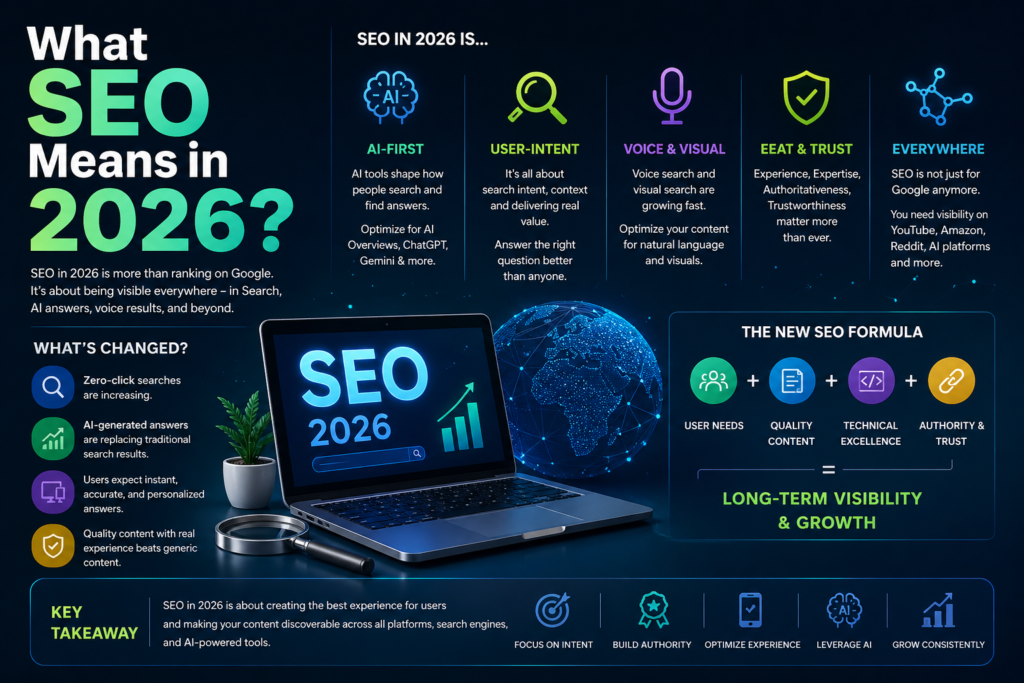
What SEO Means in 2026?
SEO in 2026 is no longer only about ranking in the blue links on Google. It is about being found wherever people search, whether that is through classic search engines, AI summaries, voice assistants, or generative search interfaces.
The core purpose of SEO is still the same: help users find the most relevant, useful, and trustworthy content. But the methods have evolved. Search engines now use advanced AI to understand context, intent, entities, and content quality much better than before.
That means keyword stuffing, thin content, and outdated tactics are no longer effective. Instead, websites need strong topical authority, helpful content, fast performance, and a better user experience.
Why AI Is Changing SEO?
Artificial intelligence is transforming how search engines interpret content and how users discover information. AI-powered systems can understand natural language, summarize pages, detect patterns, and predict what users really mean when they search.
For website owners and SEO professionals, this means search optimization must become more intelligent and more human at the same time. Content should answer real questions, anticipate follow-up questions, and provide value in a format that is easy to scan and trust.
AI is also changing content creation itself. Many people use AI tools to draft blogs, generate outlines, research topics, and optimize on-page elements. But successful SEO in 2026 will depend on human editing, originality, experience, and clarity, not just automation.
What Is AEO?
AEO stands for Answer Engine Optimization. It is the practice of optimizing your content so it can be selected as a direct answer by search engines, voice assistants, featured snippets, and AI answer systems.
Instead of only trying to rank a page, AEO focuses on making your content the best possible response to a question. This means your content should be structured clearly, written in simple language, and organized around questions people actually ask.
AEO works especially well for how-to guides, definitions, comparisons, FAQs, and step-by-step explanations. If your content is easy to extract and easy to understand, it has a much better chance of being used in answer-focused search results.
What Is GEO?
GEO stands for Generative Engine Optimization. It is the process of optimizing content so it can be discovered, understood, and referenced by generative AI search systems that create summarized answers.
Generative engines do not always display a traditional search results page. Instead, they may combine information from multiple sources and generate a response directly. That changes the SEO game because your content needs to be both trustworthy and highly quotable.
To succeed with GEO, your content should be well structured, factually strong, specific, and easy for AI systems to interpret. Clear headings, concise explanations, and authoritative content all matter more than ever.
SEO vs AEO vs GEO
These three approaches are connected, but they are not exactly the same. SEO helps your content rank in search engines, AEO helps your content answer questions directly, and GEO helps your content appear in generative AI responses.
| Focus | Main Goal | Best Content Type |
|---|---|---|
| SEO | Rank in search results | Blog posts, landing pages, product pages |
| AEO | Provide direct answers | FAQs, snippets, guides, definitions |
| GEO | Be cited or used in AI-generated answers | In-depth articles, structured content, expert pages |
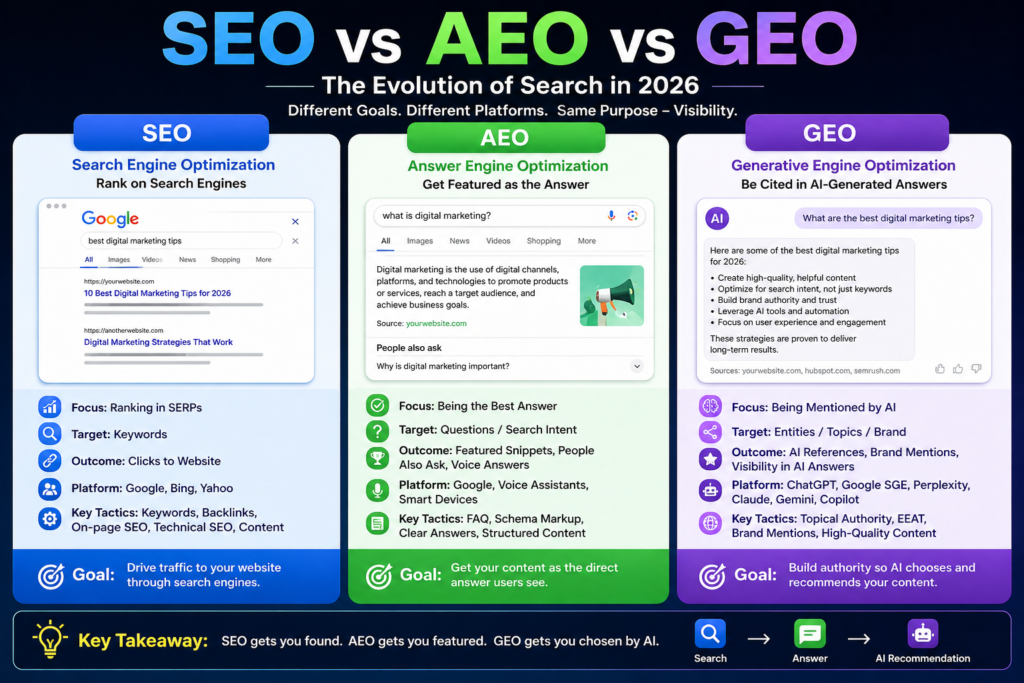
The best strategy in 2026 is not to choose one of them. It is to combine all three in one content strategy so your website can appear across multiple discovery channels.
How Search Is Evolving?
Search behavior is changing because users want faster, more complete answers. Many people now expect search engines to understand context, compare options, and summarize information instantly.
This means content must do more than include keywords. It must solve a problem, show expertise, and provide enough depth to satisfy both the reader and the machine reading the content.
Search engines are also becoming more entity-based. They care about who wrote the content, what the content is about, how it connects to related topics, and whether it demonstrates experience and trust.
How to Optimize for AI?
To optimize for AI-driven search, your content should be clear, structured, and rich in context. AI systems work better when content is easy to parse and when the meaning is obvious.
Use descriptive headings, short paragraphs, and logical flow. Answer questions directly before expanding with examples or explanations. Avoid vague wording and make sure each section focuses on one idea.
You should also strengthen your content with real examples, original insights, and practical steps. AI can generate generic text, but it is much harder to replace content that includes actual experience and useful detail.
How to Optimize for AEO?
AEO works best when your content is built around user questions. Start by identifying the exact questions your audience asks, then answer them clearly and quickly.
Use question-based headings such as “What is AEO?” or “How does GEO work?” This helps search engines and AI systems understand the purpose of each section.
Add FAQ sections, bullet points, numbered steps, and concise definitions. These formats are easier to extract for answer engines and improve readability for users.
How to Optimize for GEO?
GEO optimization requires content that AI models can trust and reuse. That means your content should be original, well organized, and supported by strong information.
To improve GEO performance, write with semantic depth. Cover related subtopics, explain terms clearly, and connect ideas logically. This helps generative engines understand the full context of your page.
Use author credibility, updated information, and strong internal linking. AI systems are more likely to rely on content that appears complete, consistent, and authoritative.
UX and SEO in 2026?
User experience is one of the most important parts of SEO in 2026. If visitors land on your page and leave quickly, search engines may interpret that as a sign the content is not satisfying.
Your blog should be easy to read on mobile, visually clean, and simple to navigate. Use short paragraphs, clear headings, enough white space, and a logical content structure.
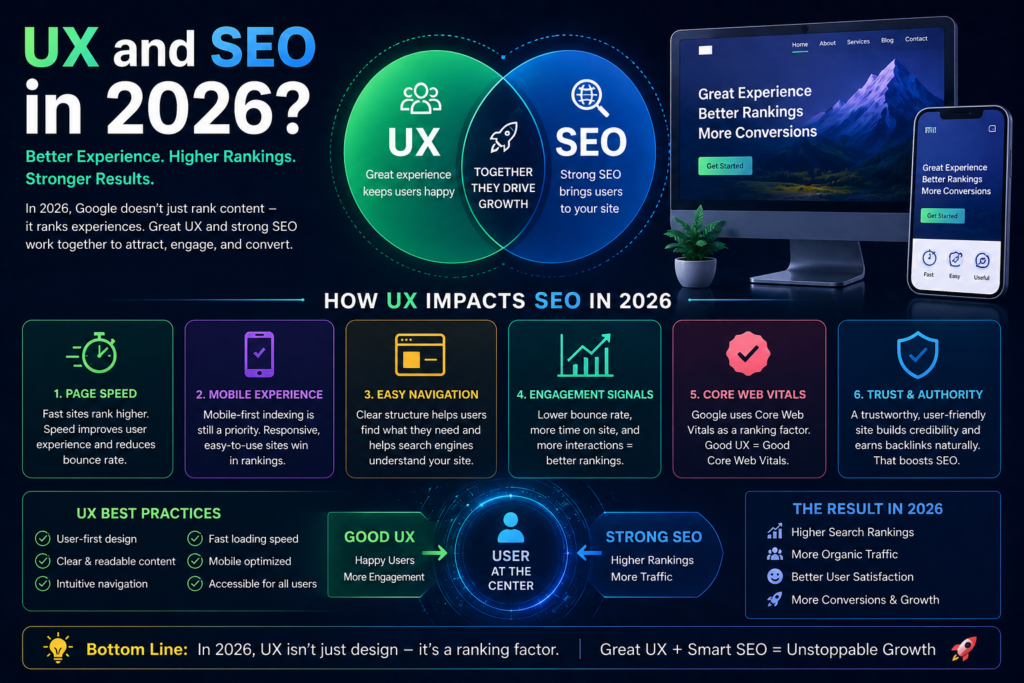
Page speed, accessibility, and mobile responsiveness also matter. A great article can still perform poorly if the page is slow, cluttered, or difficult to use.
Content Structure That Wins
A strong content structure helps both users and search systems. The best structure is simple: introduction, explanation, subtopics, examples, and conclusion.
For SEO, each section should target a related idea or question. For AEO, each answer should be direct and easy to extract. For GEO, the full article should feel complete enough for AI systems to reference confidently.
A good structure also improves dwell time and readability. When users can quickly find what they need, they are more likely to stay on the page and trust the content.
Keyword Strategy in 2026
Keyword strategy is still important, but it should be smarter than before. Instead of repeating one exact phrase too many times, build around a main keyword and related semantic terms.
For this topic, your main keyword is The Future of SEO in 2026: A Complete Guide to AI, AEO & GEO. You can also naturally include related terms like SEO 2026, AI SEO, answer engine optimization, generative engine optimization, future of search, and SEO trends.
The goal is not to force keywords into every paragraph. The goal is to create a topic-rich article that fully covers the subject in a natural, helpful way.
On-Page SEO Checklist
Before publishing, make sure your page is fully optimized. A strong on-page setup increases your chances of ranking and being understood by AI systems.
- Use the main keyword in the title.
- Add the keyword in the first paragraph.
- Use H2 and H3 headings with related terms.
- Write a strong meta title and meta description.
- Add internal links to related pages.
- Include image alt text with descriptive wording.
- Keep URLs short and clean.
- Make the content easy to read on mobile.
Why Topical Authority Matters?
Search engines and AI systems want to know whether your website is truly knowledgeable about a subject. That is why topical authority matters so much in 2026.
If your site regularly publishes strong content on SEO, AI, content marketing, search trends, and digital visibility, it becomes easier for search engines to trust your pages. One good article is useful, but a cluster of related articles is much stronger.
Topical authority also helps users. When they see that your site covers a subject in depth, they are more likely to trust your advice and return for more.
Practical Strategy for Website Owners
If you want to grow in 2026, start building content around topics, not just single keywords. Create a content cluster around SEO, AI search, AEO, GEO, and content strategy.
You should also update older posts regularly. Search trends change quickly, and fresh content often performs better than outdated information.
Focus on quality over volume. One excellent article that answers user intent deeply is more valuable than ten shallow posts that do not help anyone.
Common Mistakes to Avoid
Many websites will fail in 2026 because they are still using outdated SEO tactics. Avoid publishing thin content that says very little, even if it includes the right keywords.
Do not write only for search engines. If the content does not help a real person, it will not perform well for long.
Also avoid ignoring structure, UX, and credibility. In the future of SEO, a weak user experience can hurt performance just as much as weak content.
The Future of Search Content
The future of search content is not just about ranking pages. It is about becoming a trusted source that can be understood and surfaced across many systems.
Content will increasingly need to serve humans, AI assistants, and answer engines at the same time. That means clarity, authority, originality, and usability will become the most important ranking advantages.
Brands that adapt early will gain an edge. Those who keep using old tactics will likely see their visibility decline.
Conclusion
The future of SEO in 2026 is smarter, faster, and more human-centered than ever. Success will depend on how well you combine SEO, AEO, and GEO into one clear strategy that serves users first.
If you want your blog to rank, get cited, and remain visible in the age of AI search, focus on helpful content, strong structure, topical authority, and a great user experience. The websites that win in 2026 will be the ones that create content people trust and systems understand.