SEO vs AEO vs GEO
SEO, AEO, and GEO are three important approaches to improving online visibility. SEO (Search Engine Optimization) focuses on ranking websites on search engines like Google through keywords, content, and backlinks. AEO (Answer Engine Optimization) aims to provide direct, clear answers to user queries, helping content appear in featured snippets and voice search results. GEO (Generative Engine Optimization) focuses on optimizing content for AI-driven search systems and generative engines, ensuring your content is understood and used by tools like AI assistants. Together, these strategies help websites rank higher, gain more visibility, and adapt to the future of search.
Table of Contents
Introduction To SEO
What is SEO?
Search Engine Optimization (SEO) is the process of optimizing a website to improve its visibility in search engine results pages (SERPs). The main goal of SEO is to increase organic (non-paid) traffic by helping search engines understand your content and rank it for relevant keywords.
When users search for information on search engines like Google or Bing, SEO helps your website appear higher in the results. A well-optimized website provides valuable content, good user experience, and clear signals that search engines can easily understand.
SEO plays a crucial role in digital marketing because higher rankings often lead to more website visitors, better brand visibility, and increased conversions.
How search engines work?
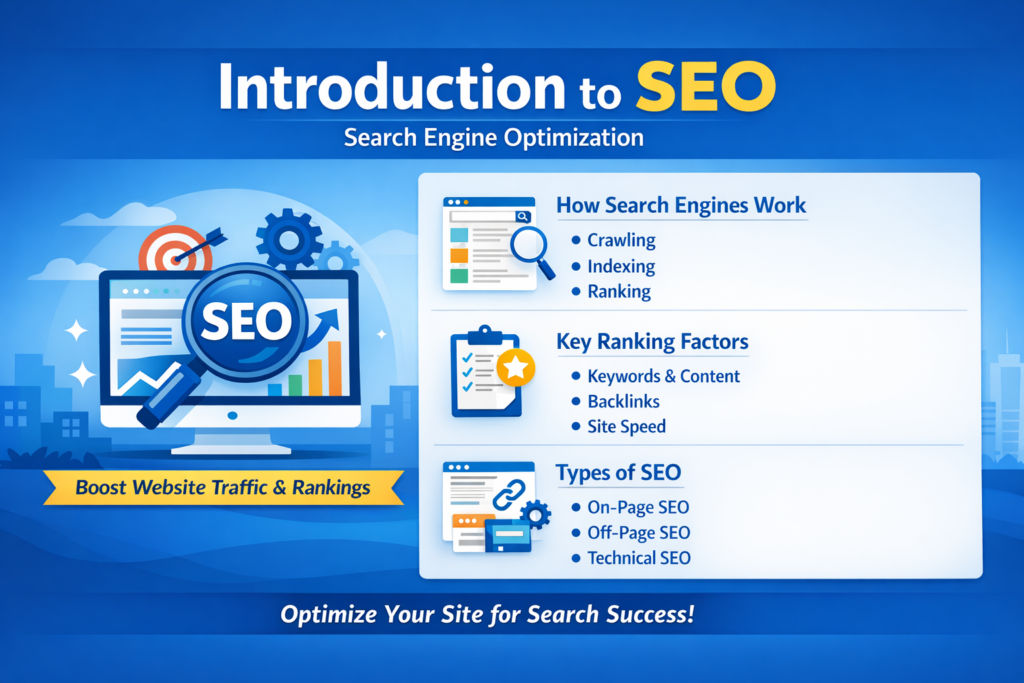
Search engines use automated systems to discover and rank web pages. This process generally involves three main steps:
1. Crawling
Search engines use bots (also called spiders) to scan the internet and discover new or updated web pages.
2. Indexing
After crawling, search engines store and organize the content in their index. Indexed pages become eligible to appear in search results.
3. Ranking
When a user performs a search query, the search engine analyzes many ranking factors to decide which pages are most relevant and useful.
SEO Ranking factors?
Search engines use many factors to determine how pages rank in search results. Some of the most important SEO ranking factors include:
- High-quality and relevant content
- Proper keyword usage
- Backlinks from authoritative websites
- Website speed and performance
- Mobile-friendly design
- Secure website (HTTPS)
- Good user experience and engagement
These factors help search engines understand the value and relevance of your website.
Types of SEO?
SEO is generally divided into three main categories, each focusing on a different aspect of website optimization.
On-page SEO focuses on optimizing elements within your website. This includes optimizing content, keywords, headings, meta tags, images, and internal links. The goal is to make your pages clear, relevant, and helpful for both users and search engines.
Off-page SEO refers to activities outside your website that help improve its authority and credibility. The most common example is building backlinks from other reputable websites. Social signals, brand mentions, and online reputation also play a role in off-page SEO.
Technical SEO focuses on improving the technical structure of a website so that search engines can crawl and index it easily. This includes website speed optimization, mobile friendliness, XML sitemaps, structured data, and fixing technical errors that may affect search performance.
Introduction To AEO
What is AEO?
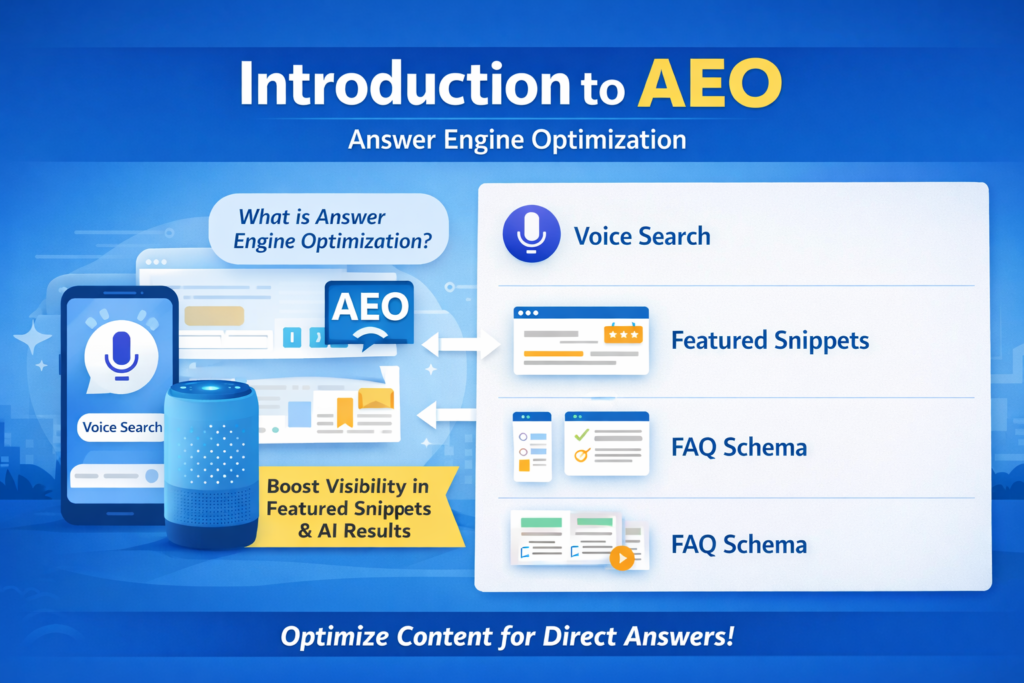
Answer Engine Optimization (AEO) is the process of optimizing content so that search engines and AI assistants can provide direct answers to users’ questions. Unlike traditional SEO, which focuses on ranking web pages, AEO focuses on delivering clear and concise answers that can appear in featured snippets, voice search results, and AI-generated responses.
With the rise of voice assistants and AI search technologies, users increasingly expect quick answers instead of browsing multiple websites. AEO helps websites structure their content in a way that search engines can easily understand and present as a direct answer.
Voice Search Optimization
Voice search has become increasingly popular with devices such as smartphones, smart speakers, and virtual assistants. When users perform voice searches, they often ask questions in a conversational way.
For example:
“What is the difference between SEO and AEO?”
To optimize for voice search, content should include natural language, question-based keywords, and clear answers. This helps voice assistants deliver accurate responses directly from your content.
Featured Snippets
Featured snippets are highlighted search results that appear at the top of Google’s search results page. They provide a quick answer to a user’s query without requiring them to click on a website.
Content that is well-structured, concise, and informative has a higher chance of appearing in featured snippets. Using headings, bullet points, and clear explanations can increase the chances of earning this position.
FAQ schema is a type of structured data that helps search engines understand the questions and answers on your webpage. By adding FAQ schema, search engines can display your content as rich results in search pages.
This improves visibility and can help your content appear in answer boxes or voice search responses.
Structured Data
Structured data is code added to a webpage that helps search engines better understand the meaning of the content. It provides additional context about topics, questions, products, and other elements.
Using structured data improves the chances of your content being selected for featured snippets, knowledge panels, and AI-generated answers.
Platforms Where AEO Matters
AEO is particularly important on platforms that provide direct answers to users.
Google Featured Snippet
Google often displays quick answers at the top of the search results. Optimizing for featured snippets can significantly increase your visibility.
Voice Search (Alexa, Google Assistant)
Voice assistants rely on structured and well-optimized content to answer user queries. AEO helps ensure your content is selected as the source for these answers.
AEO Optimization Tips
To optimize content for answer engines, consider the following strategies:
Create Question-Based Content
Write content that directly answers common user questions.
Add an FAQ Section
Including frequently asked questions helps search engines identify clear answers within your content.
Provide Clear and Concise Answers
Short, direct answers (usually 40–60 words) increase the chances of appearing in featured snippets and voice search results.
Introduction To GEO
What is GEO?
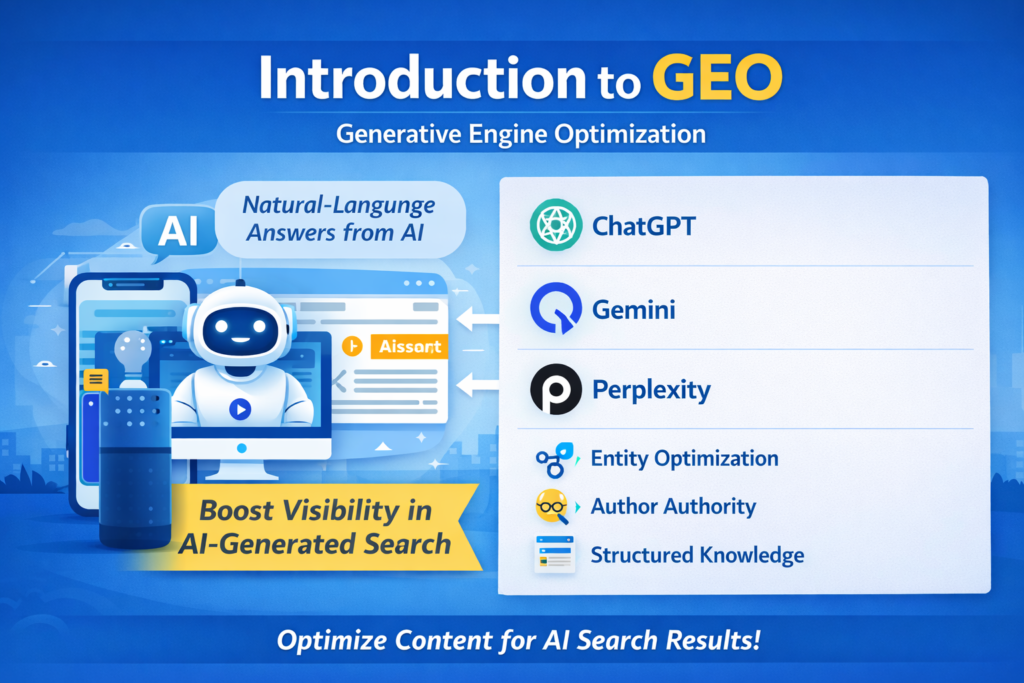
Generative Engine Optimization (GEO) is the process of optimizing content so that it can be discovered, understood, and referenced by AI-powered search engines and large language models (LLMs). Unlike traditional SEO, which focuses on ranking web pages in search results, GEO focuses on making content visible in AI-generated answers.
With the rise of AI-driven search experiences, users increasingly rely on AI tools to get instant summaries, recommendations, and explanations. GEO helps ensure that your content becomes a trusted source that AI systems can reference when generating answers.
AI Generated Answers
Modern search platforms now use artificial intelligence to generate direct answers instead of simply showing a list of links. These AI-generated responses often combine information from multiple sources to provide users with a clear and concise explanation.
If your content is well-structured, authoritative, and relevant, it has a higher chance of being used as a source for these AI-generated answers.
Large Language Models (LLMs) analyze vast amounts of data to generate responses. GEO focuses on improving LLM visibility, meaning your content becomes easier for AI models to recognize, understand, and cite when responding to user queries.
Content that demonstrates expertise, credibility, and topical authority is more likely to be referenced by AI systems.
Platforms Where GEO Matters
Generative search optimization is especially important on AI-powered platforms that generate answers for users.
ChatGPT
AI assistants like ChatGPT provide conversational responses based on large datasets and trusted sources.
Gemini
Google Gemini integrates AI-generated answers into search experiences and conversational interfaces.
Perplexity
Perplexity AI combines search and AI-generated responses by citing information from reliable sources across the web.
GEO Optimization Tips
To improve your content’s visibility in AI-generated answers, consider the following strategies:
Entity Optimization
Clearly define entities such as brands, people, and topics so AI systems can easily recognize them.
Author Authority
Establish credibility by showing expertise, author profiles, and trustworthy sources.
Structured Knowledge
Organize content logically with headings, clear explanations, and structured data so AI systems can understand it better.
Semantic SEO
Use related topics, context, and natural language to help AI models understand the deeper meaning of your content.
Key Differences: SEO vs AEO vs GEO
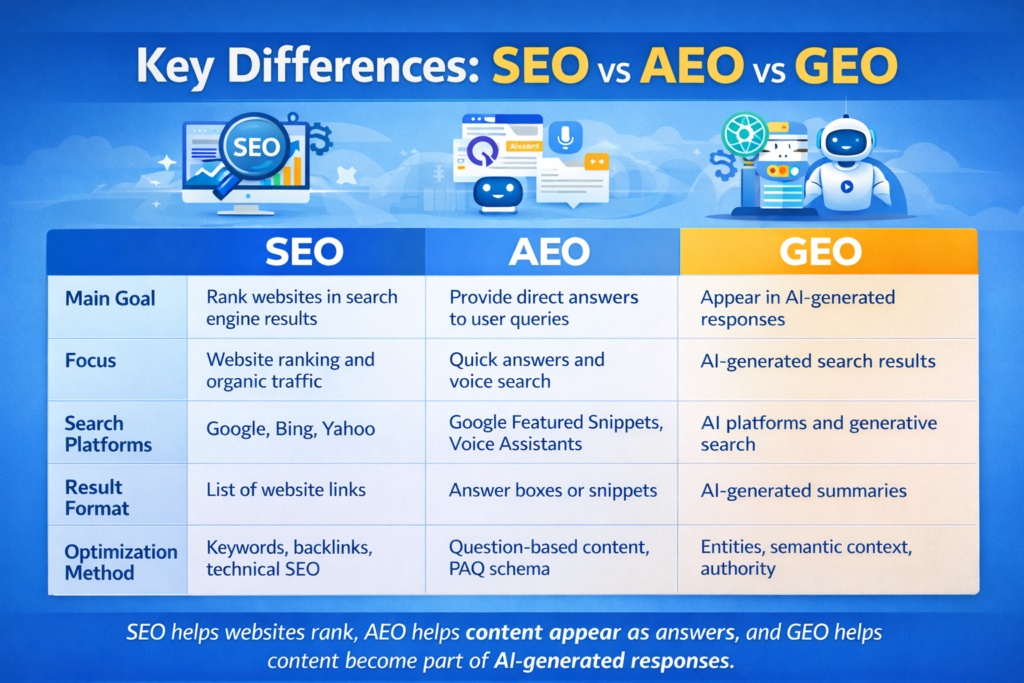
Search technology has evolved significantly over the years. Traditional Search Engine Optimization (SEO) focuses on improving a website’s ranking in search engine results pages. However, with the rise of voice assistants and AI-powered search tools, new optimization strategies such as Answer Engine Optimization (AEO) and Generative Engine Optimization (GEO) have emerged.
While all three strategies aim to improve online visibility, they differ in how content is discovered, displayed, and delivered to users. SEO focuses on ranking web pages, AEO focuses on providing direct answers to user queries, and GEO focuses on making content visible in AI-generated responses.
Understanding these differences is essential for businesses and marketers who want to stay competitive in the evolving search landscape.
SEO vs AEO vs GEO: Comparison Table
| Factor | SEO | AEO | GEO |
|---|---|---|---|
| Main Goal | Rank websites in search engine results | Provide direct answers to user queries | Appear in AI-generated responses |
| Focus | Website ranking and organic traffic | Quick answers and voice search | AI-generated search results |
| Search Platforms | Google, Bing, Yahoo | Google Featured Snippets, Voice Assistants | AI platforms and generative search |
| Result Format | List of website links | Answer boxes or snippets | AI-generated summaries |
| Optimization Method | Keywords, backlinks, technical SEO | Question-based content, FAQ schema | Entities, semantic context, authority |
| User Behavior | Users click links and explore websites | Users get instant answers | Users interact with AI for information |
Summary of Differences
In simple terms, SEO helps websites rank, AEO helps content appear as answers, and GEO helps content become part of AI-generated responses.
Businesses that focus only on traditional SEO may miss opportunities in voice search and AI-powered search experiences. By combining SEO, AEO, and GEO strategies, marketers can improve visibility across traditional search engines, answer engines, and generative AI platforms.
Future of Search (2025–2030)
The future of search is rapidly evolving as artificial intelligence continues to transform how users find information online. Traditional search engines are no longer limited to displaying lists of links. Instead, they are becoming intelligent systems that can understand context, generate answers, and deliver highly personalized experiences.
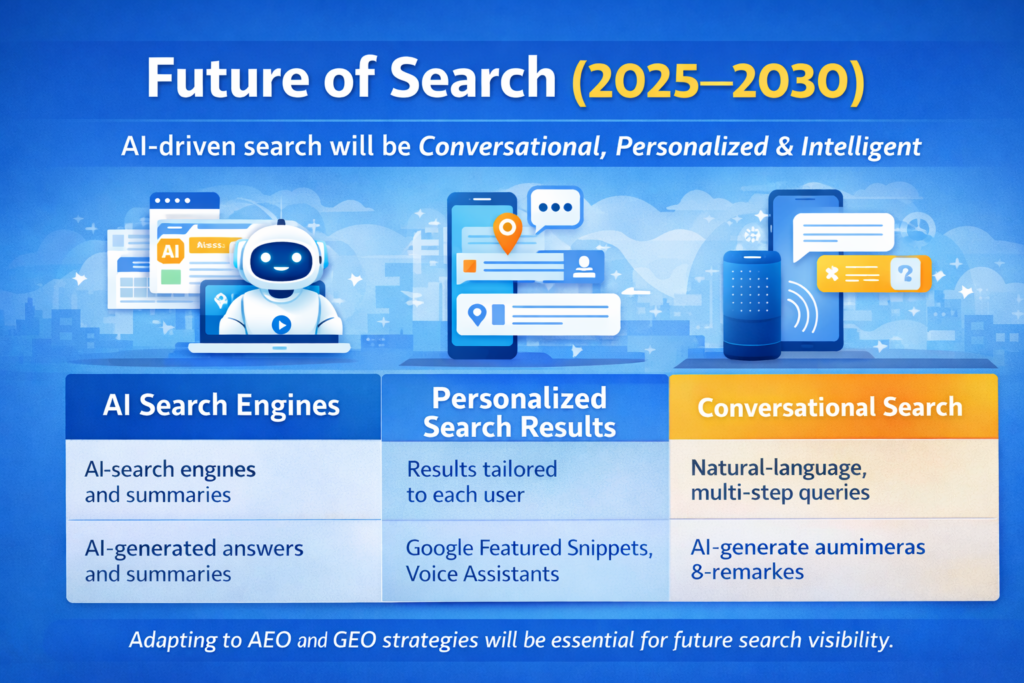
Between 2025 and 2030, search is expected to become more conversational, AI-driven, and personalized. Businesses and marketers will need to adapt their strategies by focusing not only on traditional SEO but also on AEO and GEO to stay visible in this new search landscape.
AI Search Engines
AI-powered search engines are reshaping how users access information. Instead of manually browsing multiple websites, users can now receive summarized answers generated by artificial intelligence.
Platforms powered by generative AI are designed to understand complex queries and provide accurate responses in a conversational format. As AI search engines continue to evolve, websites that provide clear, structured, and authoritative content will have a higher chance of being referenced in AI-generated answers.
Personalized Search Results
Search results are becoming increasingly personalized based on a user’s behavior, location, interests, and search history. AI systems analyze these signals to deliver results that are more relevant to individual users.
This means two users searching for the same query may see completely different results. Businesses must focus on creating high-quality content, strong brand authority, and user-focused experiences to remain visible in personalized search environments.
Conversational Search
Conversational search is another major trend shaping the future of search. Instead of typing short keywords, users now interact with search systems using natural language questions and multi-step queries.
Voice assistants and AI chat interfaces allow users to ask follow-up questions and receive contextual responses. This shift makes it essential for content creators to write in a clear, natural, and question-based format that matches how people actually speak and search.
Conclusion
Search optimization is evolving rapidly as technology and user behavior continue to change. While traditional SEO remains the foundation of digital visibility, newer approaches like AEO and GEO are becoming increasingly important in the modern search landscape.
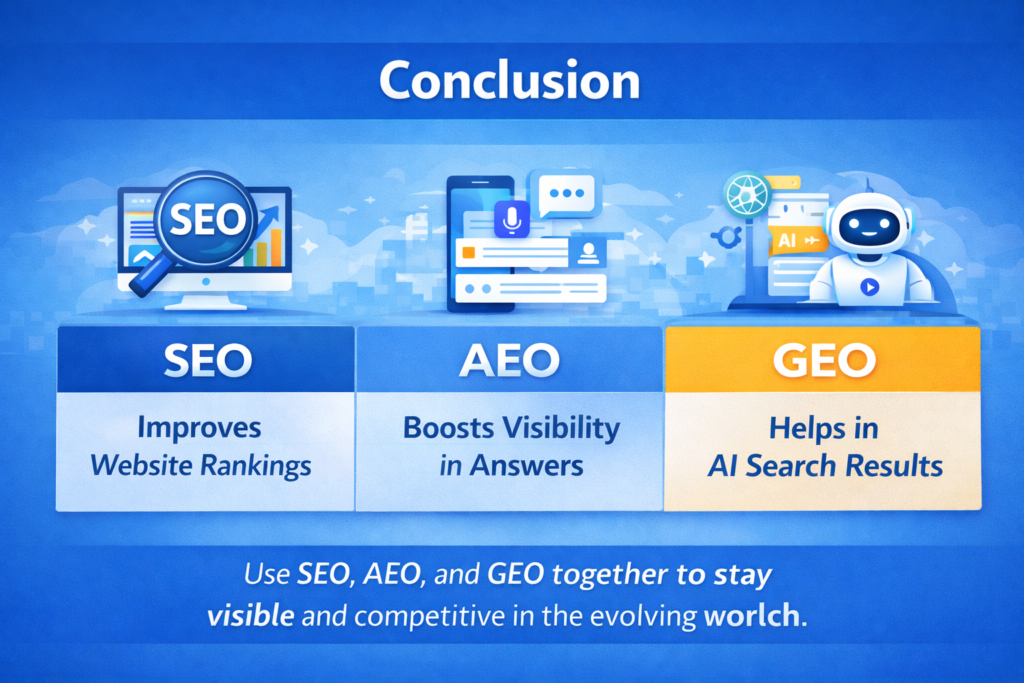
SEO focuses on improving website rankings and driving organic traffic from search engines. AEO enhances visibility by providing clear and direct answers, helping content appear in featured snippets and voice search results. Meanwhile, GEO ensures that content is recognized and referenced by AI-powered search platforms that generate responses using advanced language models.
To stay competitive in the future of search, businesses and marketers should combine SEO, AEO, and GEO strategies. By creating high-quality content, answering user questions clearly, and structuring information effectively, it becomes easier to reach users across traditional search engines, answer engines, and AI-driven search platforms.