

Complete SEO Learning Guide For 2026
This page is a complete SEO learning guide for 2026 that explains how modern search engine optimization works. It covers the fundamentals of SEO, including how search engines crawl, index, and rank websites, along with the importance of SEO for increasing website visibility and organic traffic.
The guide also explains different types of SEO such as on-page SEO, technical SEO, off-page SEO, local SEO, e-commerce SEO, mobile SEO, international SEO, and enterprise SEO. In addition, it includes detailed information about keyword research, different types of keywords, and the most important SEO tools used to analyze performance and improve rankings.
Overall, this page provides a beginner-friendly and structured overview of SEO strategies, techniques, and tools needed to grow website traffic and improve search visibility in 2026.
Table of Contents
Introduction to Search Engine Optimization
What is Search Engine Optimization in 2026?
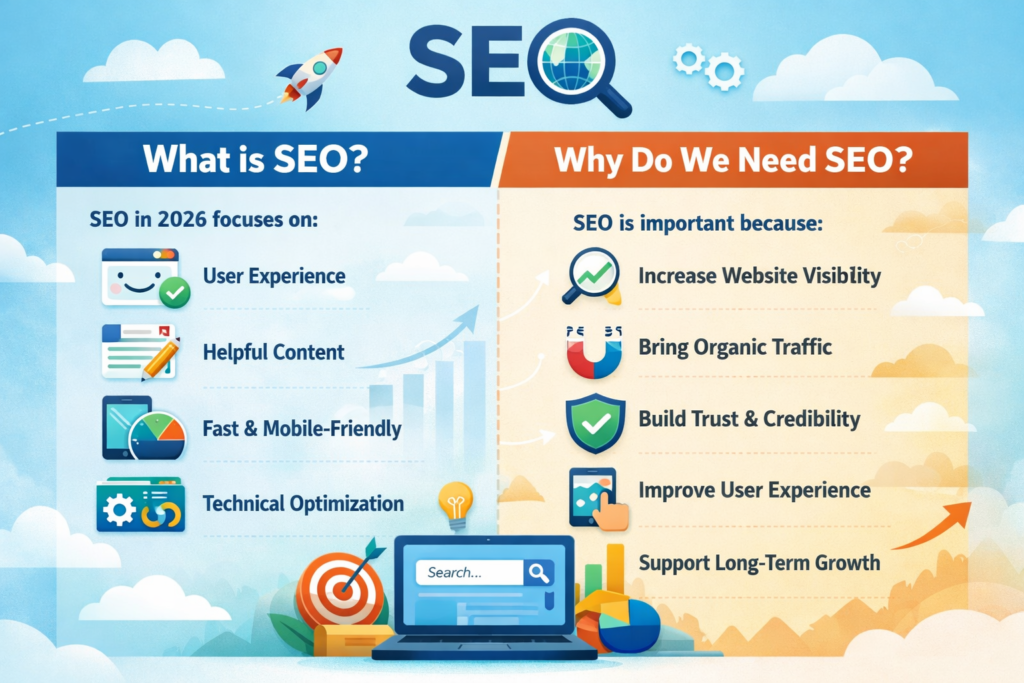
SEO in 2026 focuses more on user experience, helpful content, and website performance rather than just keywords and backlinks. Search engines like Google now prioritize websites that provide clear, valuable information and a smooth browsing experience.
Modern SEO involves understanding search intent, creating high-quality content, optimizing website speed, and ensuring mobile friendliness. In simple terms, SEO in 2026 is about helping both search engines and users easily understand and trust your website.
Why Do We Need SEO?
SEO is important because it helps websites become more visible on search engines like Google. When your website is optimized properly, it becomes easier for people to find your content, products, or services online. This increases traffic and helps build trust with your audience over time.
Key reasons why SEO is important:
- Increase Website Visibility – SEO helps your website appear higher in search engine results.
- Bring Organic Traffic – It attracts visitors naturally without relying only on paid ads.
- Build Trust and Credibility – Websites that rank higher are often seen as more reliable.
- Improve User Experience – SEO also focuses on faster loading, better structure, and mobile-friendly design.
- Support Long-Term Growth – Good SEO can bring consistent traffic and help grow your online presence over time.
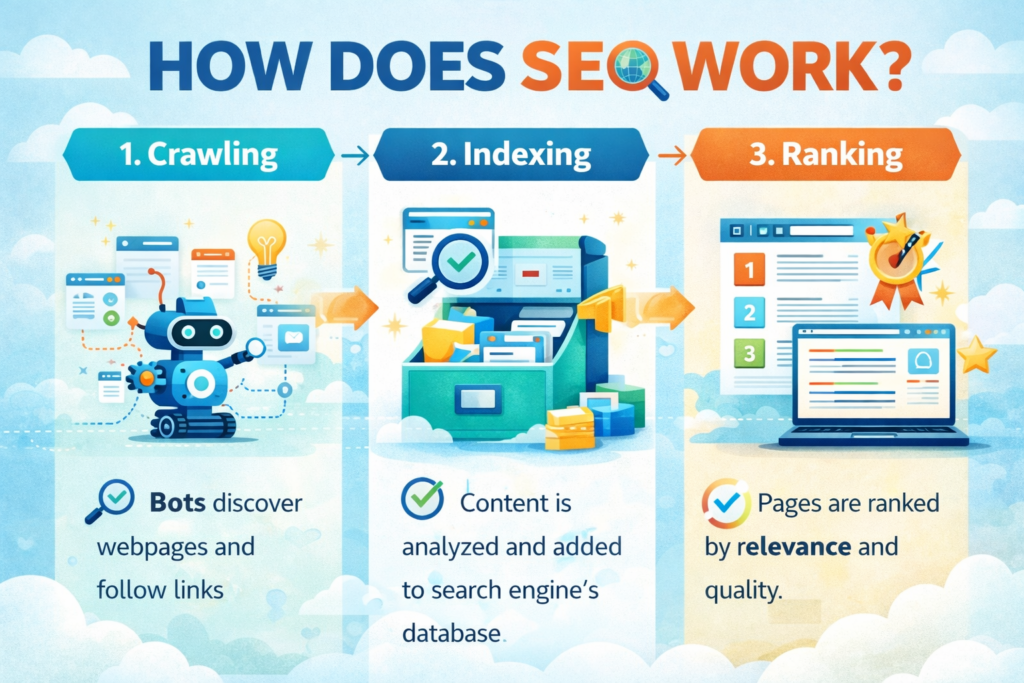
SEO works by helping search engines understand your website and decide when it should appear in search results. When someone searches for information, products, or services on Google, search engines try to show the most relevant and helpful webpages. SEO improves your website so that search engines can easily find, understand, and rank your content.
Search engines mainly follow three important steps to make this happen:
1. Crawling
Search engines use automated programs called crawlers or bots to discover webpages on the internet. These bots scan websites, follow links, and find new or updated content.
2. Indexing
After crawling a page, search engines analyze the content and store the information in their database. This process is called indexing. If a page is properly optimized, it can be added to the search engine index.
3. Ranking
When a user searches for something, the search engine quickly goes through its index and ranks pages based on relevance, content quality, authority, and user experience. The most useful pages appear at the top of the search results.
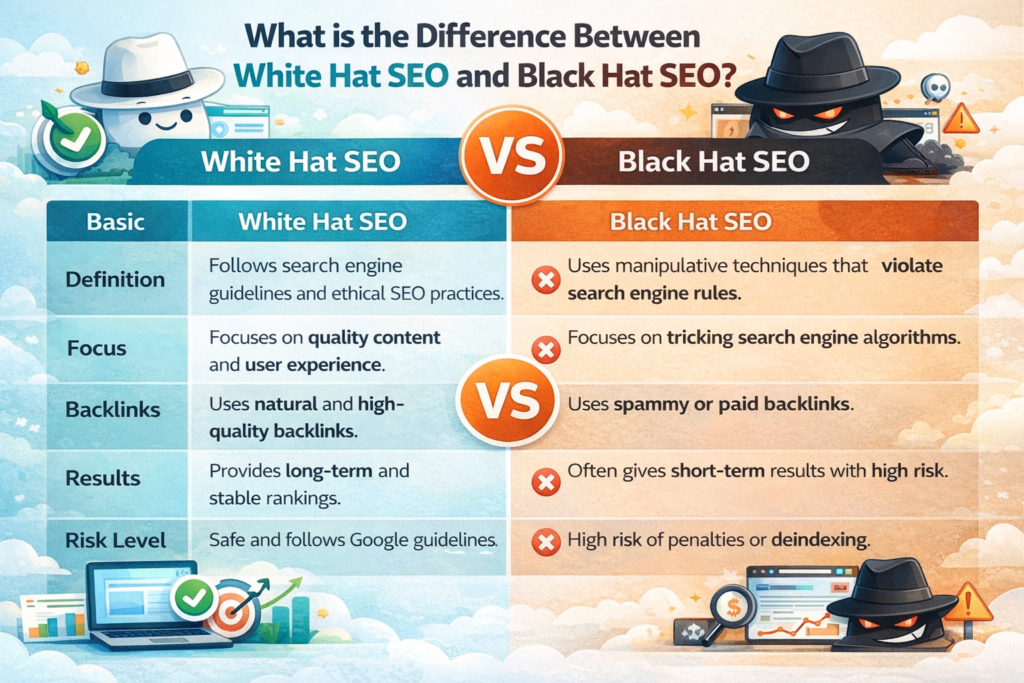
What is the difference between White Hat SEO and Black Hat SEO?
| Basics | White Hat SEO | Black Hat SEO |
| Definition | Follows search engine guidelines and ethical SEO practices. | Uses manipulative techniques that violate search engine rules. |
| Focus | Focuses on quality content and user experience. | Focuses on tricking search engine algorithms |
| Backlinks | Uses natural and high-quality backlinks. | Uses spammy or paid backlinks. |
| Results | Provides long-term and stable rankings. | Often gives short-term results with high risk. |
| Risk Level | Safe and follows Google guidelines | High risk of penalties or deindexing. |
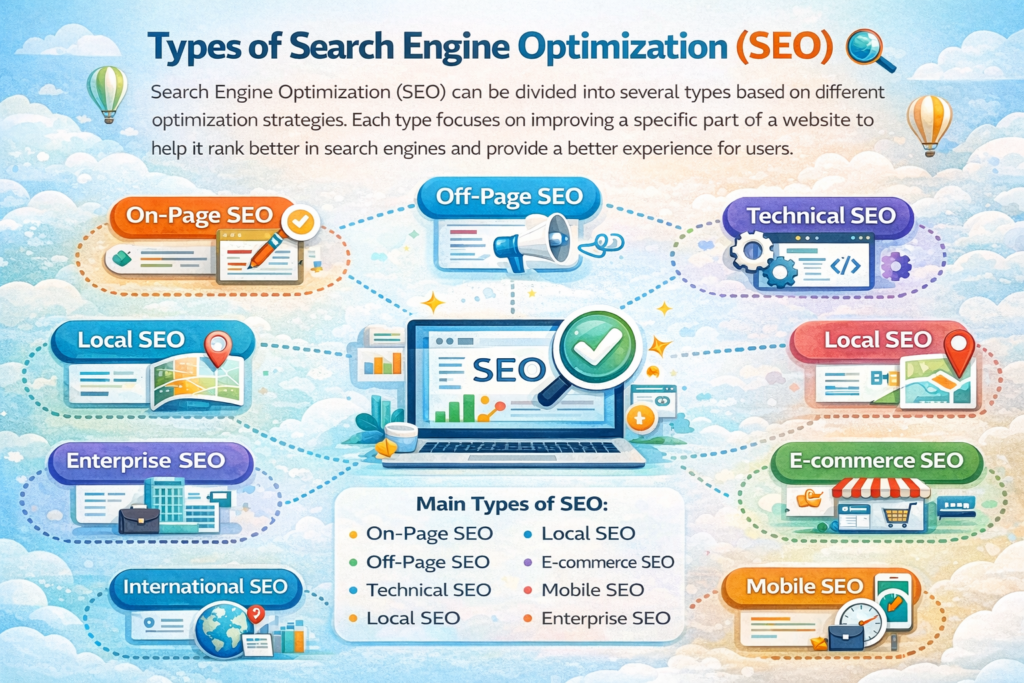
Types of Search Engine Optimization
Search Engine Optimization (SEO) can be divided into several types based on different optimization strategies. Each type focuses on improving a specific part of a website to help it rank better in search engines and provide a better experience for users.
Main Types of SEO:
- On-Page SEO
- Off-Page SEO
- Technical SEO
- Local SEO
- E-commerce SEO
- Mobile SEO
- International SEO
- Enterprise SEO
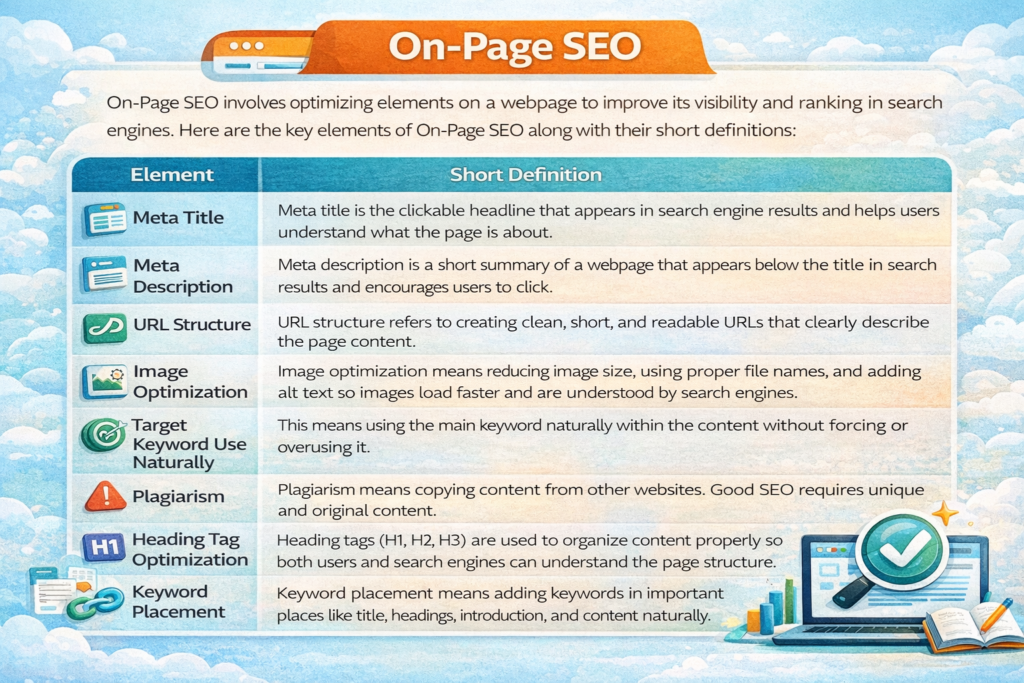
On Page SEO:-
On-Page SEO refers to the process of optimizing elements within a webpage to improve its visibility and ranking in search engines. It focuses on improving content quality, structure, and other on-page factors so that both users and search engines can easily understand the page.
Key elements of On-Page SEO:
| Checklists | Explanation |
| Meta Title | Meta title is the clickable headline that appears in search engine results and helps users understand what the page is about. |
| Meta Description | Meta description is a short summary of a webpage that appears below the title in search results and encourages users to click. |
| URL Structure | URL structure refers to creating clean, short, and readable URLs that clearly describe the page content. |
| Image Optimization | Image optimization means reducing image size, using proper file names, and adding alt text so images load faster and are understood by search engines. |
| Target Keyword Use Naturally | This means using the main keyword naturally within the content without forcing or overusing it. |
| Plagiarism | Plagiarism means copying content from other websites. Good SEO requires unique and original content. |
| Heading Tag Optimization | Heading tags (H1, H2, H3) are used to organize content properly so both users and search engines can understand the page structure. |
| Internal Link and External Link | Internal links connect pages within the same website, while external links point to other trusted websites. |
| Keyword Placement | Keyword placement means adding keywords in important places like title, headings, introduction, and content naturally. |
| Grammar | Proper grammar ensures the content is clear, professional, and easy for users to read and understand. |
Technical SEO:-
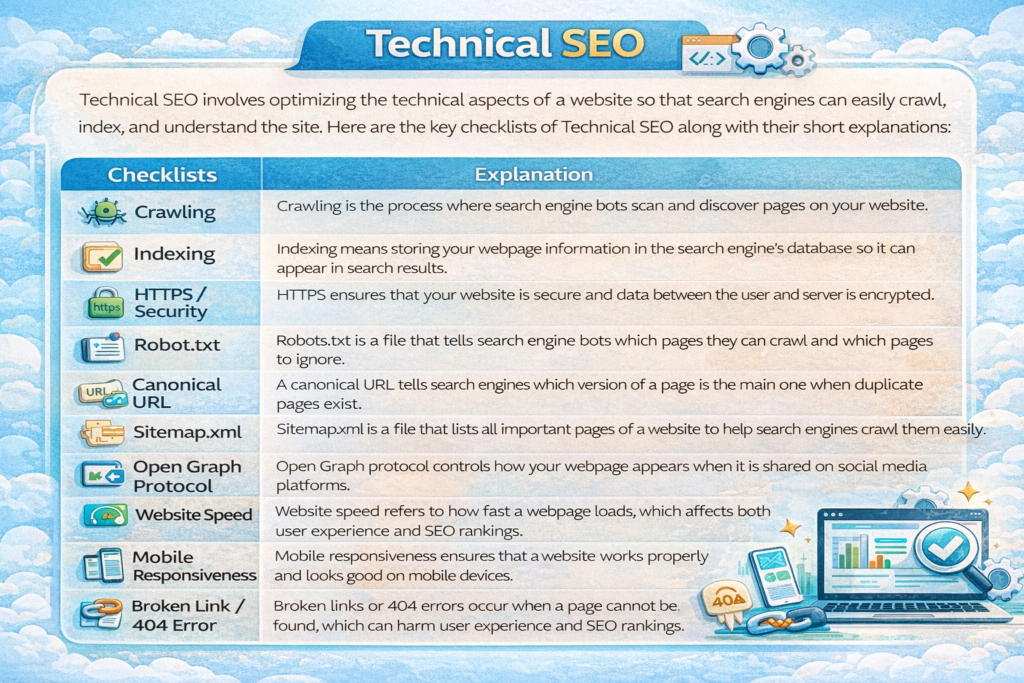
Technical SEO refers to optimizing the technical aspects of a website so that search engines can easily crawl, index, and understand the site. It focuses on improving website performance, structure, and accessibility to help search engines properly analyze the website.
Key elements of Technical SEO:
| Checklists | Explanation |
| Crawling | Crawling is the process where search engine bots scan and discover pages on your website. |
| Indexing | Indexing means storing your webpage information in the search engine’s database so it can appear in search results. |
| HTTPS/Security | HTTPS ensures that your website is secure and data between the user and server is encrypted. |
| Robot.txt | Robots.txt is a file that tells search engine bots which pages they can crawl and which pages to ignore. |
| Canonical url | A canonical URL tells search engines which version of a page is the main one when duplicate pages exist. |
| Sitemap.xml | Sitemap.xml is a file that lists all important pages of a website to help search engines crawl them easily. |
| Open Graph Protocol | Open Graph protocol controls how your webpage appears when it is shared on social media platforms. |
| Website Speed | Website speed refers to how fast a webpage loads, which affects both user experience and SEO rankings. |
| Mobile Responsiveness | Mobile responsiveness ensures that a website works properly and looks good on mobile devices. |
| Broken Link/404 Error | Broken links or 404 errors occur when a page cannot be found, which can harm user experience and SEO. |
| Schema Tag | Schema markup is structured data that helps search engines better understand the content of a webpage. |
Off Page SEO:-
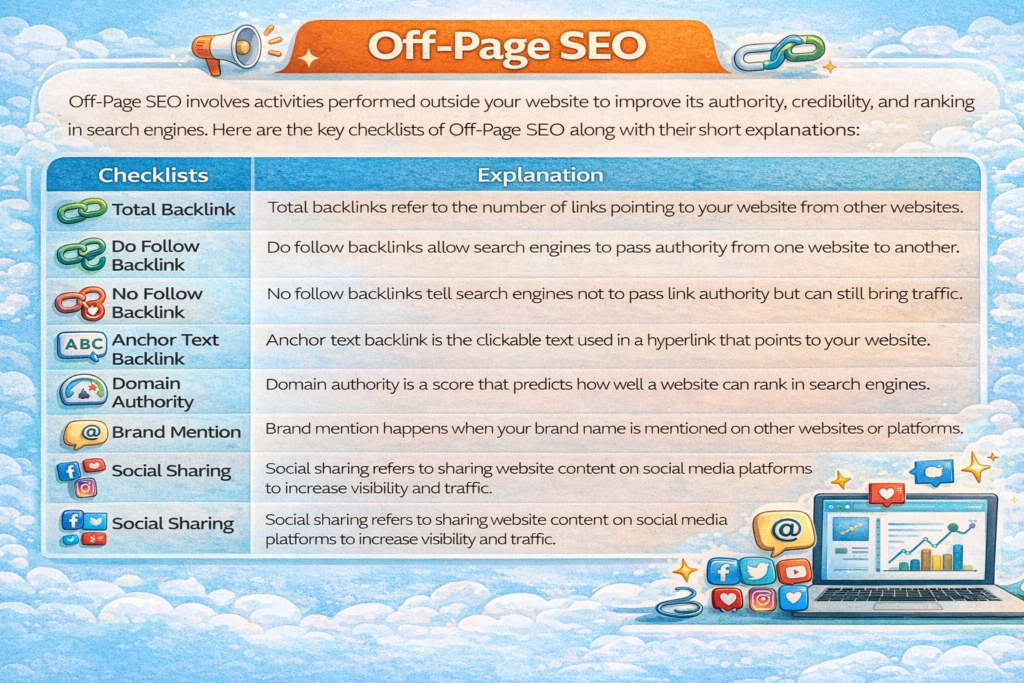
Off-Page SEO refers to activities performed outside of your website to improve its authority, credibility, and ranking in search engines. It mainly focuses on building trust and reputation for a website through external signals like backlinks, brand mentions, and social engagement.
Key elements of Off-Page SEO:
| Checklists | Explanation |
| Total Backlink | Total backlinks refer to the number of links pointing to your website from other websites. |
| Do Follow Backlink | Do follow backlinks allow search engines to pass authority from one website to another. |
| No Follow Backlink | No follow backlinks tell search engines not to pass link authority but can still bring traffic |
| Anchor Text Backlink | Anchor text backlink is the clickable text used in a hyperlink that points to your website. |
| Domain Authority | Domain authority is a score that predicts how well a website can rank in search engines. |
| Brand Mention | Brand mention happens when your brand name is mentioned on other websites or platforms. |
| Social Sharing | Social sharing refers to sharing website content on social media platforms to increase visibility and traffic. |
Local SEO:-
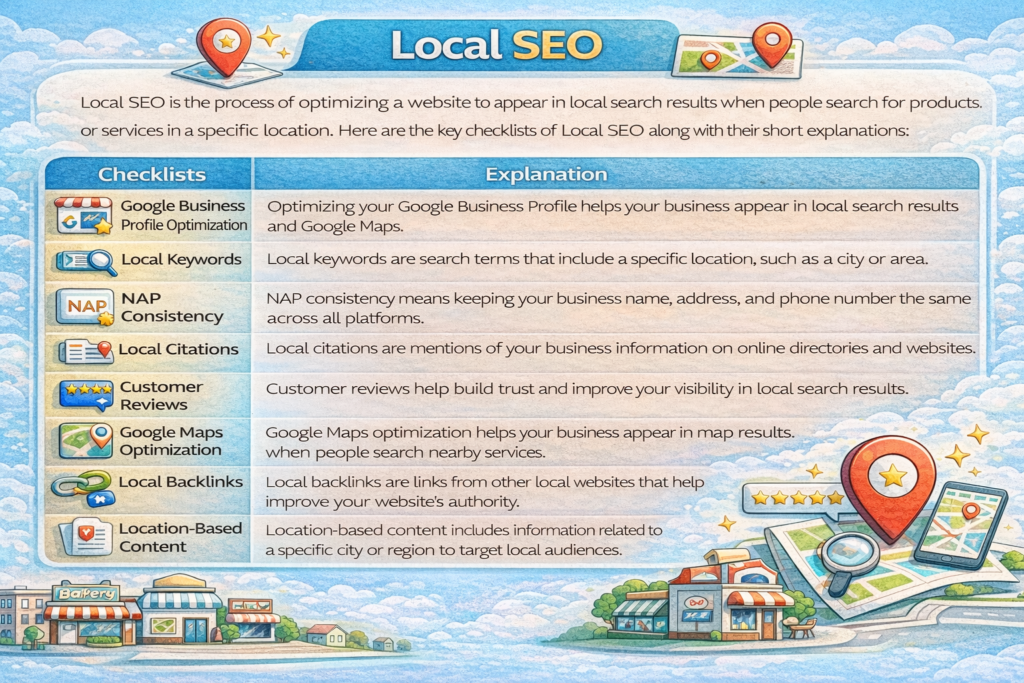
Local SEO is the process of optimizing a website to appear in local search results when people search for products or services in a specific location. It helps businesses reach nearby customers and improve visibility in local searches on Google.
Key elements of Local SEO:
| Checklists | Explanation |
| Google Business Profile Optimization | Optimizing your Google Business Profile helps your business appear in local search results and Google Maps. |
| Local Keywords | Local keywords are search terms that include a specific location, such as a city or area. |
| NAP Consistency (Name, Address, Phone Number) | NAP consistency means keeping your business name, address, and phone number the same across all platforms. |
| Local Citations | Local citations are mentions of your business information on online directories and websites. |
| Customer Reviews | Customer reviews help build trust and improve your visibility in local search results. |
| Google Maps Optimization | Google Maps optimization helps your business appear in map results when people search nearby services. |
| Local Backlinks | Local backlinks are links from other local websites that help improve your website’s authority. |
| Location-Based Content | Location-based content includes information related to a specific city or region to target local audiences. |
E-Commerce SEO:-
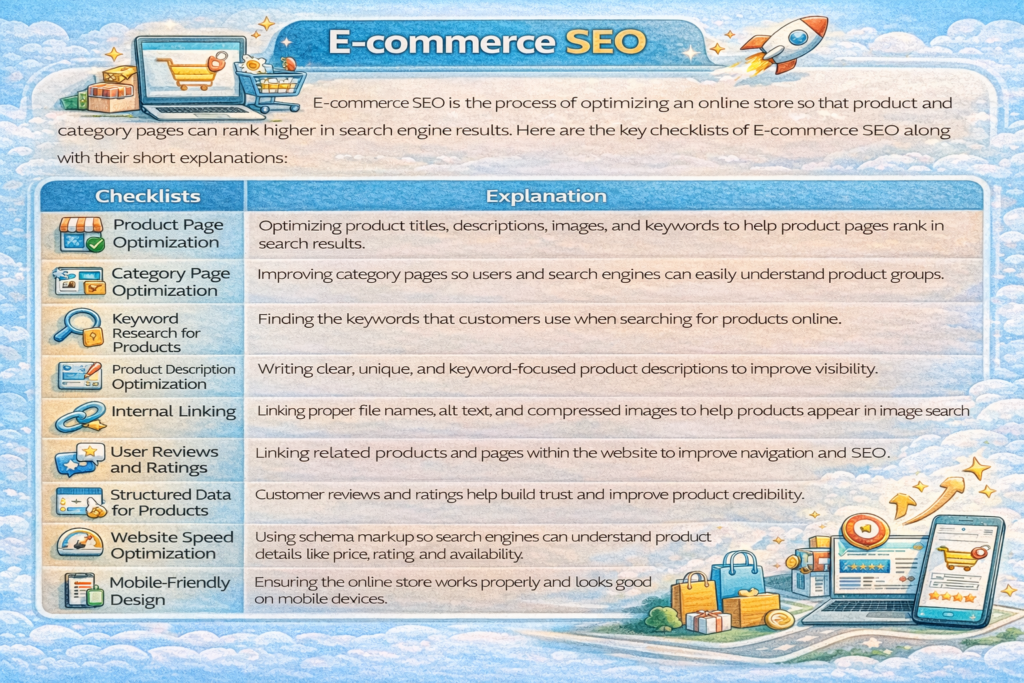
E-commerce SEO is the process of optimizing an online store so that product and category pages can rank higher in search engine results. It helps online businesses attract more organic traffic and increase product visibility in search engines like Google.
Key elements of E-commerce SEO:
| Checklists | Explanation |
|---|---|
| Product Page Optimization | Optimizing product titles, descriptions, images, and keywords to help product pages rank in search results. |
| Category Page Optimization | Improving category pages so users and search engines can easily understand product groups. |
| Keyword Research for Products | Finding the keywords that customers use when searching for products online. |
| Product Description Optimization | Writing clear, unique, and keyword-focused product descriptions to improve visibility. |
| Image Optimization for Products | Using proper file names, alt text, and compressed images to help products appear in image search and load faster. |
| Internal Linking | Linking related products and pages within the website to improve navigation and SEO. |
| User Reviews and Ratings | Customer reviews and ratings help build trust and improve product credibility. |
| Structured Data for Products | Using schema markup so search engines can understand product details like price, rating, and availability. |
| Website Speed Optimization | Improving page loading speed to provide better user experience and SEO performance. |
| Mobile-Friendly Design | Ensuring the online store works properly and looks good on mobile devices. |
Mobile SEO:-
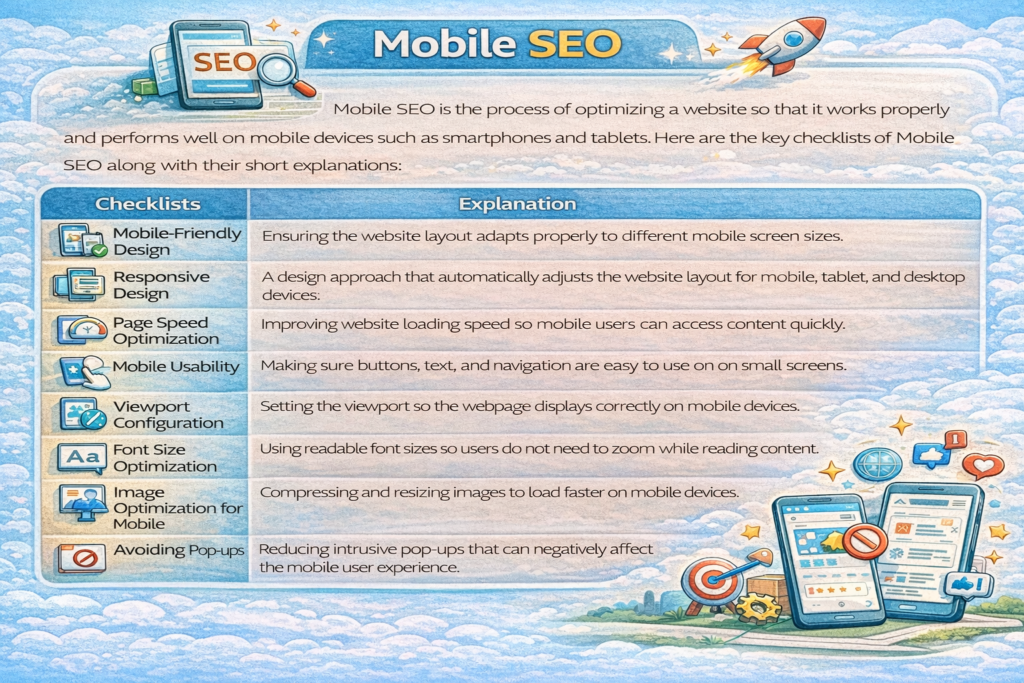
Mobile SEO is the process of optimizing a website so that it works properly and performs well on mobile devices such as smartphones and tablets. It focuses on improving mobile user experience, loading speed, and mobile-friendly design to help websites rank better in mobile search results.
Key elements of Mobile SEO:
| Checklists | Explanation |
|---|---|
| Mobile-Friendly Design | Ensuring the website layout adapts properly to different mobile screen sizes. |
| Responsive Design | A design approach that automatically adjusts the website layout for mobile, tablet, and desktop devices. |
| Page Speed Optimization | Improving website loading speed so mobile users can access content quickly. |
| Mobile Usability | Making sure buttons, text, and navigation are easy to use on small screens. |
| Viewport Configuration | Setting the viewport so the webpage displays correctly on mobile devices. |
| Font Size Optimization | Using readable font sizes so users do not need to zoom while reading content. |
| Image Optimization for Mobile | Compressing and resizing images to load faster on mobile devices. |
| Avoiding Pop-ups | Reducing intrusive pop-ups that can negatively affect the mobile user experience. |
International SEO:-
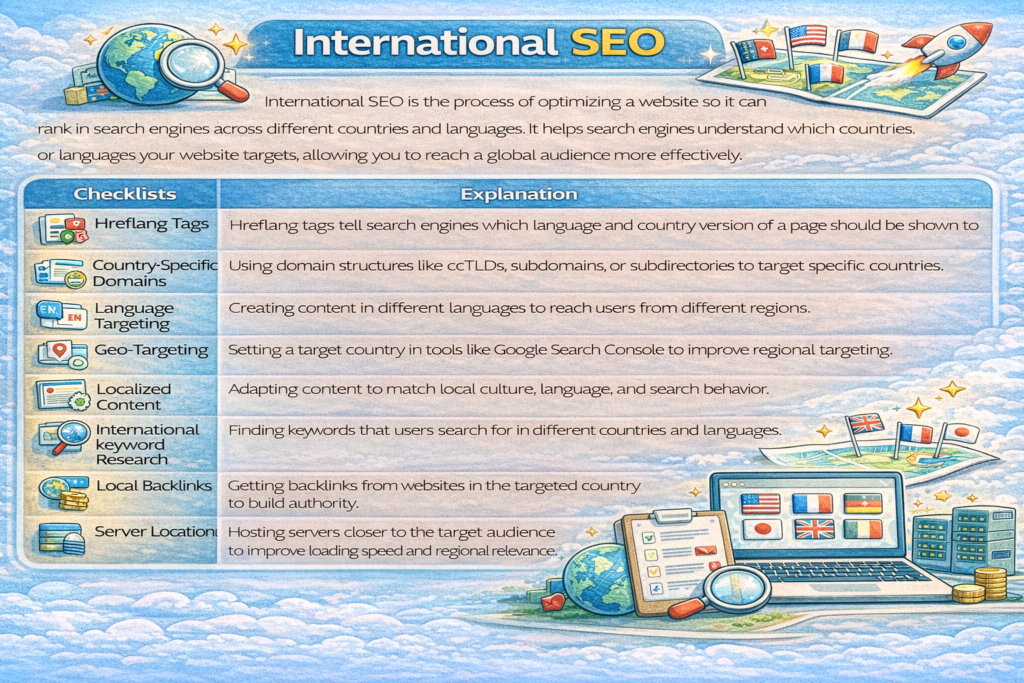
International SEO is the process of optimizing a website so it can rank in search engines across different countries and languages. It helps search engines understand which countries or languages your website targets, allowing you to reach a global audience more effectively.
Key elements Of International SEO:
| Checklists | Explanation |
|---|---|
| Hreflang Tags | Hreflang tags tell search engines which language and country version of a page should be shown to users. |
| Country-Specific Domains | Using domain structures like ccTLDs, subdomains, or subdirectories to target specific countries. |
| Language Targeting | Creating content in different languages to reach users from different regions. |
| Geo-Targeting | Setting a target country in tools like Google Search Console to improve regional targeting. |
| Localized Content | Adapting content to match local culture, language, and search behavior. |
| International Keyword Research | Finding keywords that users search for in different countries and languages. |
| Local Backlinks | Getting backlinks from websites in the targeted country to build authority. |
| Server Location | Hosting servers closer to the target audience to improve loading speed and regional relevance. |
Enterprise SEO:-
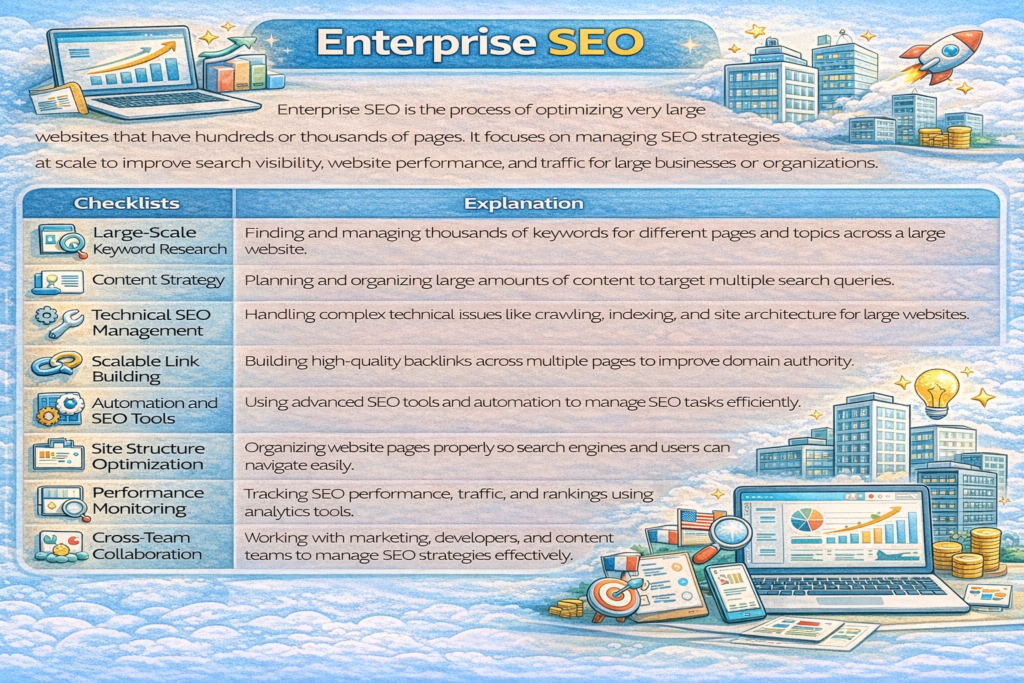
Enterprise SEO is the process of optimizing very large websites that have hundreds or thousands of pages. It focuses on managing SEO strategies at scale to improve search visibility, website performance, and traffic for large businesses or organizations.
Key elements of Enterprise SEO:
| Checklists | Explanation |
|---|---|
| Large-Scale Keyword Research | Finding and managing thousands of keywords for different pages and topics across a large website. |
| Content Strategy | Planning and organizing large amounts of content to target multiple search queries. |
| Technical SEO Management | Handling complex technical issues like crawling, indexing, and site architecture for large websites. |
| Scalable Link Building | Building high-quality backlinks across multiple pages to improve domain authority. |
| Automation and SEO Tools | Using advanced SEO tools and automation to manage SEO tasks efficiently. |
| Site Structure Optimization | Organizing website pages properly so search engines and users can navigate easily. |
| Performance Monitoring | Tracking SEO performance, traffic, and rankings using analytics tools. |
| Cross-Team Collaboration | Working with marketing, developers, and content teams to manage SEO strategies effectively. |
Keyword Research in Search Engine Optimization
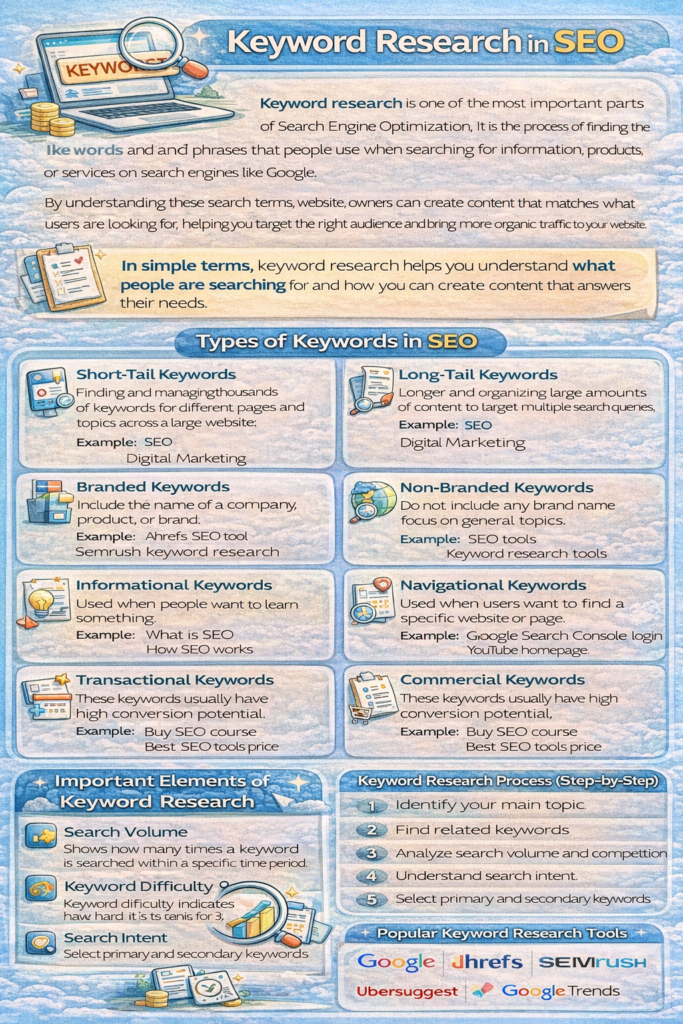
Keyword research is one of the most important parts of Search Engine Optimization. It is the process of finding the words and phrases that people use when searching for information, products, or services on search engines like Google.
By understanding these search terms, website owners can create content that matches what users are looking for. Proper keyword research helps websites target the right audience, improve search engine rankings, and bring more organic traffic.
In simple terms, keyword research helps you understand what people are searching for and how you can create content that answers their needs.
| Types | Explanation | Example | Importance |
| Short-Tail-Keyword | Short-tail keywords are very broad search terms that usually contain one or two words. | “Digital Marketing” | These keywords have high search volume but also very high competition. |
| Long-Tail-Keyword | Long-tail keywords are longer and more specific search phrases | “Best SEO tools for beginners” | They usually have lower competition and higher conversion rates. |
| Branded-Keyword | Branded keywords include the name of a company, product, or brand. | “Semrush keyword research” | Users searching these keywords usually already know the brand. |
| Non-Branded-Keyword | These keywords do not include any brand name and focus on general topics. | “Keyword research tools” | These are useful for attracting a new audience. |
| Informational Keyword | These keywords are used when people want to learn something. | “How SEO works” | They are commonly used in blog posts and guides. |
| Navigational Keyword | Navigational keywords are used when users want to find a specific website or page. | “Google Search Console login” | Navigational keywords are important because they help users quickly find a specific website, brand, or page they are already looking for. |
| Commercial Keyword | Transactional keywords show that the user wants to buy something. | “Best SEO tools price” | These keywords usually have high conversion potential. |
| Transactional Keyword | Commercial keywords are search terms used by people who are researching products or services before making a purchase. These users are interested in comparing options, reading reviews, or finding the best solution before buying. | “Top digital marketing courses” | These keywords are important because they attract users who are close to making a buying decision. |
Top SEO Tools for 2026
SEO tools help website owners analyze performance, find the right keywords, track rankings, and improve overall search visibility. Using the right tools makes SEO work faster, more accurate, and easier to manage.
| SEO Tool | Why It Is One of the Best |
|---|---|
| Ahrefs | Ahrefs is one of the most powerful SEO tools for backlink analysis, keyword research, and competitor analysis. It provides a large database and accurate SEO insights. |
| Semrush | SEMrush is an all-in-one SEO platform that helps with keyword research, site audits, competitor tracking, and content optimization. |
| Google Search Console | This free tool from Google helps monitor website performance, fix indexing issues, and understand how your site appears in Google search results. |
| Google Analytics | Google Analytics helps track website traffic, user behavior, and conversions, which is essential for understanding SEO performance. |
| Ubersuggest | Ubersuggest is a beginner-friendly SEO tool that provides keyword ideas, competition data, and content suggestions. |