
Answer Engine Optimization (AEO) Guide
This page is a complete guide to Answer Engine Optimization (AEO) that explains how modern search engines and AI platforms deliver direct answers to user questions. It covers the fundamentals of AEO, including how answer engines work, the differences between traditional SEO and AEO, and how search has evolved from link-based results to voice search and AI-generated answers.
The guide also explains question-based keyword research, content structure for AEO, featured snippet optimization, voice search optimization, and schema markup. In addition, it includes strategies for optimizing content for AI search and advanced AEO techniques such as entity SEO, semantic SEO, NLP optimization, E-E-A-T signals, and content clustering.
Overall, this page provides a structured overview of how to create clear, answer-focused content that can appear in featured snippets, voice search results, and AI-generated answers.
Table of Contents
Introduction to Answer Engine Optimization
What is Answer Engine Optimization (AEO)?
AEO is the process of optimizing content so that search engines and AI platforms can easily understand it and deliver direct and accurate answers to users’ questions. Instead of only focusing on ranking web pages in search results, AEO focuses on providing clear, structured, and helpful information that can appear directly in answer boxes.
Content optimized for AEO is usually written in a way that makes it easy for search engines to identify the most relevant answer. This type of content often appears in featured snippets, voice search results, and AI-generated answers, helping users quickly find the information they are looking for.
How does Answer Engine Optimization work?
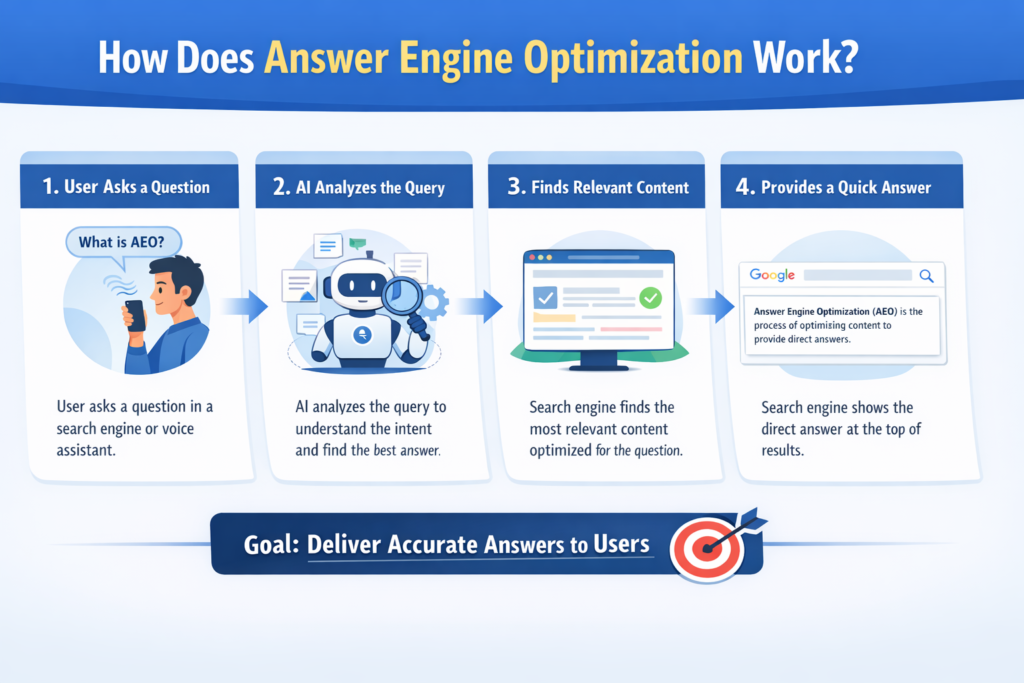
Answer Engine Optimization works by helping search engines understand content clearly so they can deliver direct answers to users’ questions. Instead of only ranking webpages, AEO focuses on creating structured and easy-to-understand information.
When a user asks a question, search engines scan different webpages and choose the content that gives the clearest and most relevant answer. Content with question-based headings, concise explanations, and organized structure has a higher chance of appearing in featured snippets or AI-generated answers.
Key factors that help AEO work:
- Clear question-based headings
- Direct and concise answers
- Well-structured content (H1, H2, H3)
- Use of bullet points or lists
What is the difference between AEO and traditional SEO?
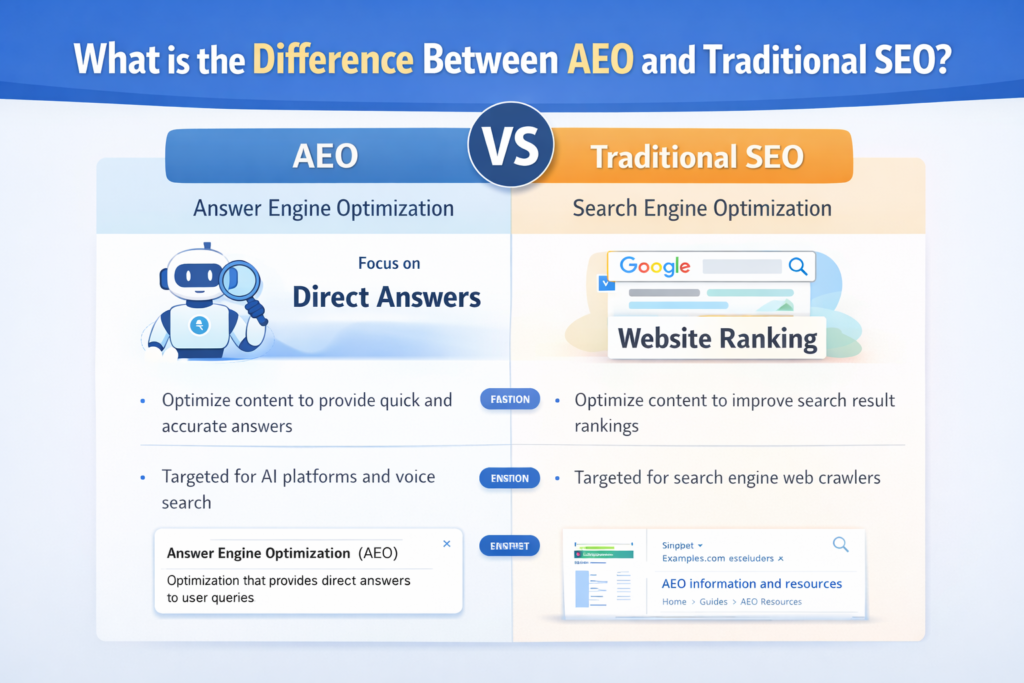
The main difference between Answer Engine Optimization (AEO) and traditional SEO is how content is optimized for search results. Traditional SEO focuses on ranking webpages higher in search engine results pages (SERPs), while AEO focuses on providing direct answers to user questions.
Traditional SEO aims to bring users to a website through search rankings, whereas AEO helps content appear directly in featured snippets, voice search results, and AI-generated answers. This means AEO prioritizes clear, structured, and question-based content that search engines can easily understand.
| Feature | Traditional SEO | AEO |
|---|---|---|
| Main goal | Rank webpages on search engines | Provide direct answers to questions |
| Content focus | Keywords and long articles | Clear and concise answers |
| Search results | Organic website links | Featured snippets, voice search, AI answers |
| User behavior | Users click and visit websites | Users get answers instantly |
How do search engines provide direct answers to users?
Search engines provide direct answers by analyzing webpages and selecting the most relevant information for a user’s query. Instead of only showing links, they often display the best answer directly on the search results page. Content that is clear, concise, and well-structured has a higher chance of being selected.
Common ways search engines show direct answers:
- Featured Snippets – Short answers shown at the top of search results
- People Also Ask (PAA) – Related questions with quick answers
- Voice Search Results – Spoken answers from voice assistants
- AI-generated answers – Summarized answers created using multiple sources
How has search evolved from traditional search to voice and AI answers?
Search has changed significantly over time. Earlier, search engines mainly showed a list of website links, and users had to visit different pages to find the information they needed. Today, search engines aim to provide faster and more direct answers to user queries.
With the growth of voice assistants and AI technologies, search engines can now understand natural language and deliver instant responses. This shift has led to the rise of voice search and AI-generated answers, where users can get information quickly without browsing multiple websites.
| Search Stage | How It Works |
|---|---|
| Traditional Search | Shows a list of website links for users to explore |
| Voice Search | Users ask questions using voice assistants |
| AI Answers | Search engines generate direct and summarized answers |
Why is Answer Engine Optimization important in modern SEO?
Answer Engine Optimization is important in modern SEO because search engines now aim to provide quick and direct answers to users. Instead of only showing website links, many search results now include featured snippets, voice search responses, and AI-generated answers.
By optimizing content for AEO, websites can increase their chances of appearing in these direct answer formats. This helps content become more visible and useful for users who want fast and accurate information.
Why AEO matters in modern SEO:
- Helps content appear in featured snippets
- Improves visibility in voice search results
- Supports AI-generated search answers
- Provides faster information to users
Keyword Research for AEO
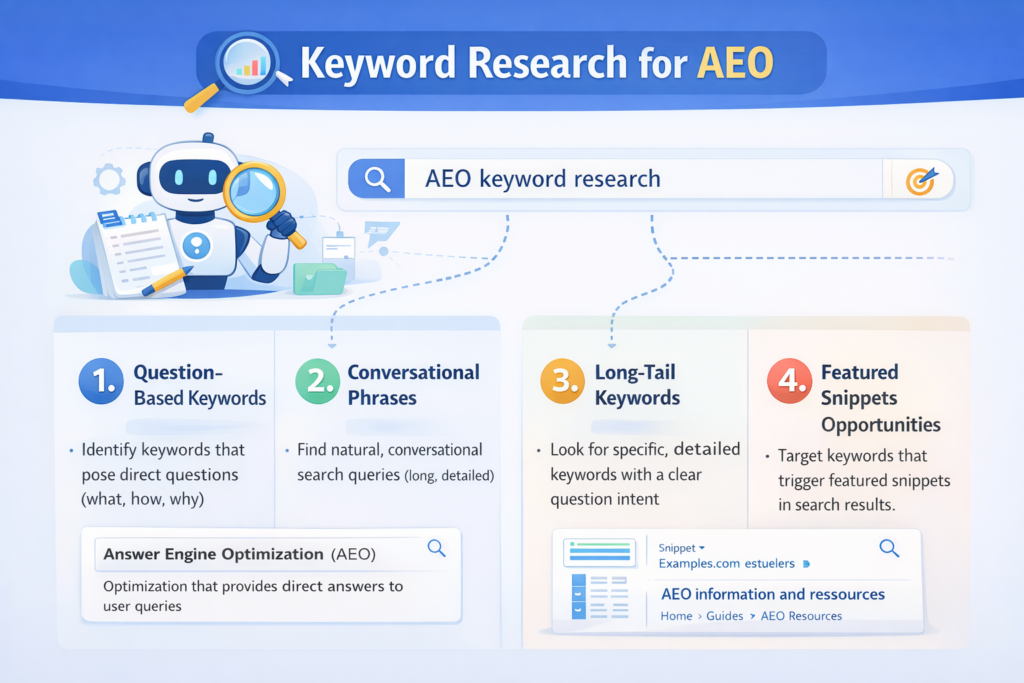
Keyword research for AEO focuses on finding the questions users ask in search engines. Unlike traditional SEO, AEO prioritizes question-based and long-tail keywords because search engines often use these queries to generate direct answers. By targeting the right keywords, content becomes easier for search engines and AI systems to understand and display as helpful answers.
What is informational search intent?
Informational search intent refers to queries where users are looking for information or answers rather than trying to buy something. These searches usually start with words like what, how, why, when, or which. Content optimized for informational intent often has a higher chance of appearing in featured snippets and AI answers.
How to find question-based keywords for AEO?
Question-based keywords are important because AEO focuses on answering user questions clearly.
Ways to find them:
- Check Google’s People Also Ask (PAA) section
- Look at autocomplete suggestions in search
- Analyze common questions related to your topic
- Use keyword research tools that show question queries
What is a long-tail keyword strategy in AEO?
A long-tail keyword strategy focuses on targeting specific and detailed search queries instead of short generic keywords. These keywords usually have lower competition and clearer search intent, making them ideal for AEO.
Example:
| Short Keyword | Long-Tail Keyword |
|---|---|
| AEO | What is Answer Engine Optimization in SEO |
| SEO strategy | How to optimize content for AEO |
Long-tail keywords help content match user questions more accurately.
Several tools can help identify question-based and long-tail keywords for AEO.
Which tools help in question keyword research?
Common tools include:
- AnswerThePublic – Finds common user questions
- AlsoAsked – Shows related question queries
- Google Search (PAA) – Provides real user questions
- Google Trends – Shows trending search topics
Using these tools helps identify the questions people ask, making it easier to create content that search engines can use for direct answers.
Content Structure for AEO
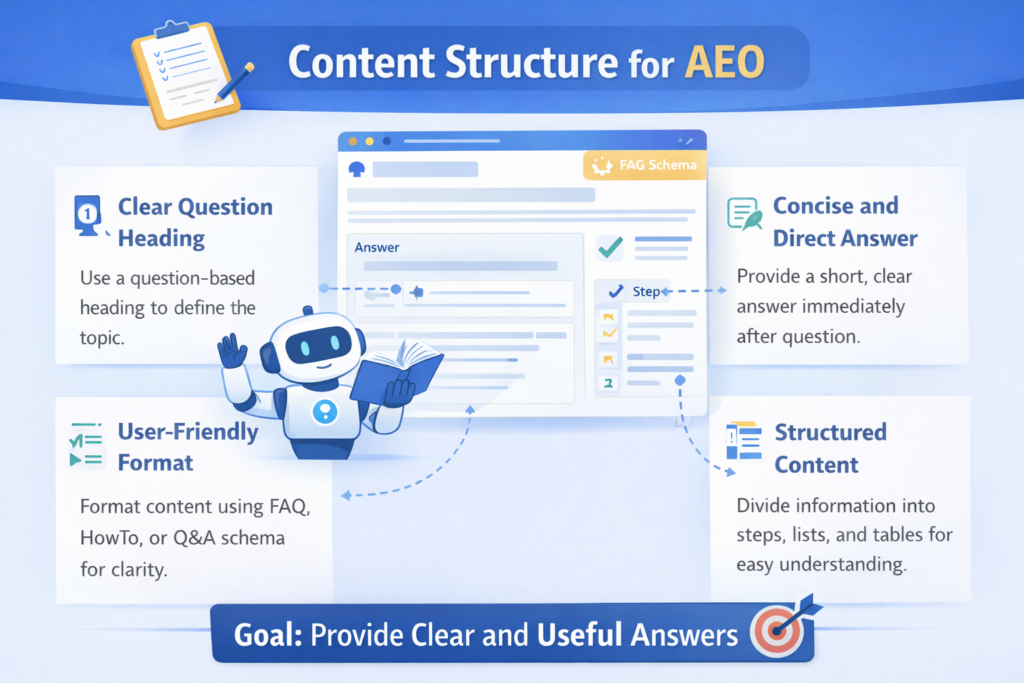
A strong content structure is essential for Answer Engine Optimization (AEO) because search engines and AI systems prefer information that is clear, organized, and easy to understand. Well-structured content helps search engines quickly identify the main answer and present it in formats like featured snippets, voice search responses, and AI-generated answers.
What is question-based content structure in AEO?
Question-based content structure means organizing content around real questions that users search for online. Instead of writing only general headings, content is structured using question-style headings such as what, how, why, or which.
This approach helps search engines understand that the content directly answers a user’s query. When content clearly matches a question, it becomes easier for search engines and AI platforms to display that answer in search results.
What is the short answer paragraph technique?
The short answer paragraph technique is a method where a clear and concise answer is provided immediately after a question heading. Usually, the answer is written in 2–3 simple sentences that directly explain the topic.
This technique helps search engines quickly identify the main answer and use it for featured snippets or AI summaries. After the short answer, additional explanation can be added to provide more details for readers.
Why are structured headings (H1, H2, H3) important for AEO?
Structured headings help organize content so both users and search engines can easily understand the topic hierarchy.
Benefits of structured headings:
- Make content easier to scan and read
- Help search engines understand the topic structure
- Improve chances of appearing in featured snippets
- Support AI systems in extracting clear answers
Using headings like H1 for the main topic, H2 for sections, and H3 for subtopics creates a logical structure that improves content visibility.
How do bullet point answers help in AEO optimization?
Bullet points make information clear, concise, and easy to process. Search engines often prefer bullet lists because they quickly summarize important points.
Advantages of bullet points:
- Improve readability for users
- Highlight key information quickly
- Increase chances of appearing in list snippets
- Help AI systems extract important points easily
Because of this, bullet points are commonly used in AEO-optimized content.
How can tables improve answer engine optimization?
Tables organize information in a simple and structured format, making it easier for search engines and readers to compare details.
For example:
| Content Format | Benefit for AEO |
|---|---|
| Paragraph | Explains concepts clearly |
| Bullet Points | Highlights key information |
| Table | Makes comparisons easy |
Tables help search engines understand relationships between data and sometimes appear directly in search result snippets.
Why are step-by-step answers effective for AEO?
Step-by-step answers explain a process in a clear and logical order, which makes them very helpful for users.
Why they work well:
- Easy for readers to follow
- Perfect for “how-to” queries
- Can appear in list snippets
- Useful for voice search responses
Because of their clear structure, step-by-step explanations are often selected by search engines as direct answers for instructional queries.
How to Optimize Content for Featured Snippets?
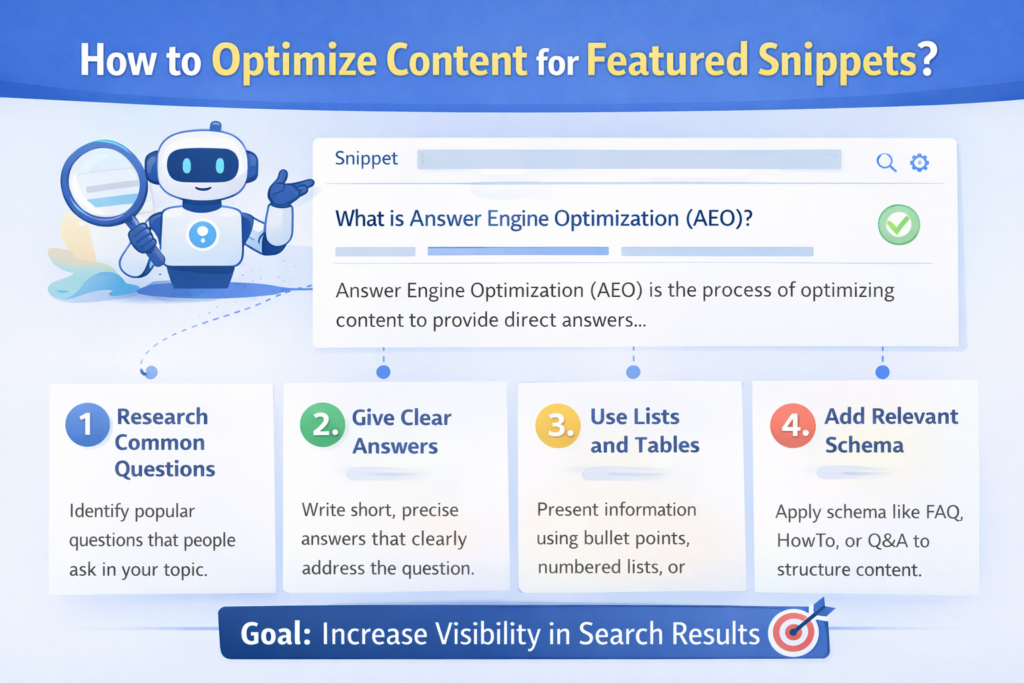
Featured snippets are special search results where Google displays a direct answer at the top of the search results page. These snippets are designed to quickly answer a user’s question without requiring them to open multiple websites.
Optimizing content for featured snippets is an important part of Answer Engine Optimization (AEO) because it increases the chances of your content appearing as the primary answer in search results.
Types Of featured snippets:
Search engines use different snippet formats depending on the type of information.
1. Paragraph Snippet
A paragraph snippet shows a short text answer that explains a question clearly. These snippets usually appear for queries like what is, why, or how.
2. List Snippet
List snippets display information in a numbered or bullet list format. They are commonly used for step-by-step guides or tips.
3. Table Snippet
Table snippets present information in a structured table format, making it easy for users to compare data.
4. Video Snippet
Video snippets show a relevant video result that answers a user’s question visually, often from platforms like YouTube.
Featured Snippet Optimization Strategy:
To increase the chances of appearing in featured snippets, content should follow a clear and structured format.
Key optimization strategies:
- Write a 40–60 word direct answer immediately after the question heading
- Use clear heading structure (H1, H2, H3) for better organization
- Use numbered lists for step-by-step information
- Present data using tables when comparisons are needed
Voice Search Optimization In AEO
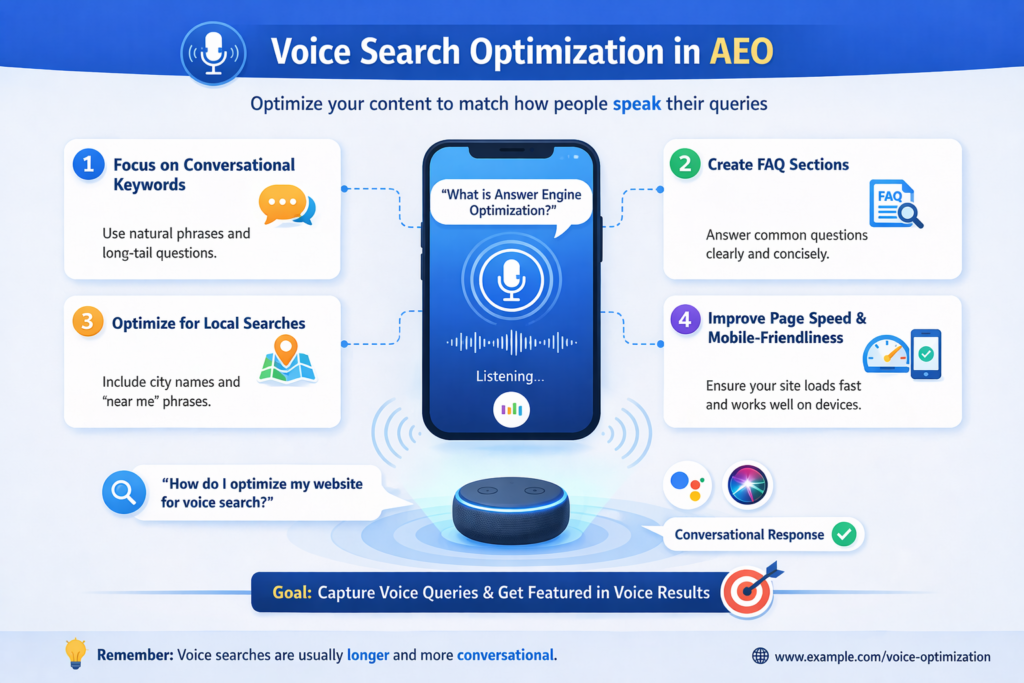
Voice search optimization focuses on optimizing content so that it can be easily understood and used by voice assistants and AI-powered search systems. With the growth of smart devices and voice assistants, many users now search by speaking instead of typing. Because of this, content should be structured in a way that clearly answers spoken questions.
How Does Voice Search work?
Voice search works by allowing users to ask questions using voice commands through devices like smartphones, smart speakers, or voice assistants. The system converts the spoken query into text, analyzes the intent, and then finds the most relevant answer from available content.
Search engines usually prefer clear, concise, and well-structured answers when selecting results for voice search.
What Are Conversational Keywords?
Conversational keywords are natural and question-based phrases that people use when speaking. Unlike traditional keywords, voice search queries are often longer and more conversational.
Example:
| Typed Search | Voice Search |
|---|---|
| AEO guide | What is Answer Engine Optimization guide |
| SEO tips | What are the best SEO tips for beginners |
Using conversational keywords helps content match how people actually speak during voice searches.
What Are Natural Language Queries?
Natural language queries are searches written or spoken in a complete and natural sentence. These queries reflect how people normally ask questions in everyday conversations.
For example:
Instead of typing “AEO meaning”, a user may ask “What is Answer Engine Optimization?”
Content that answers these natural language queries clearly has a better chance of appearing in voice search results and AI answers.
What Is Local Voice Search?
Local voice search refers to queries where users look for nearby businesses or services using voice commands. These searches usually include phrases like near me or in my area.
Examples:
- “Best SEO expert near me”
- “Digital marketing agency in my city”
Optimizing content with location-based keywords and clear business information helps improve visibility in local voice search results.
Schema Markup In AEO
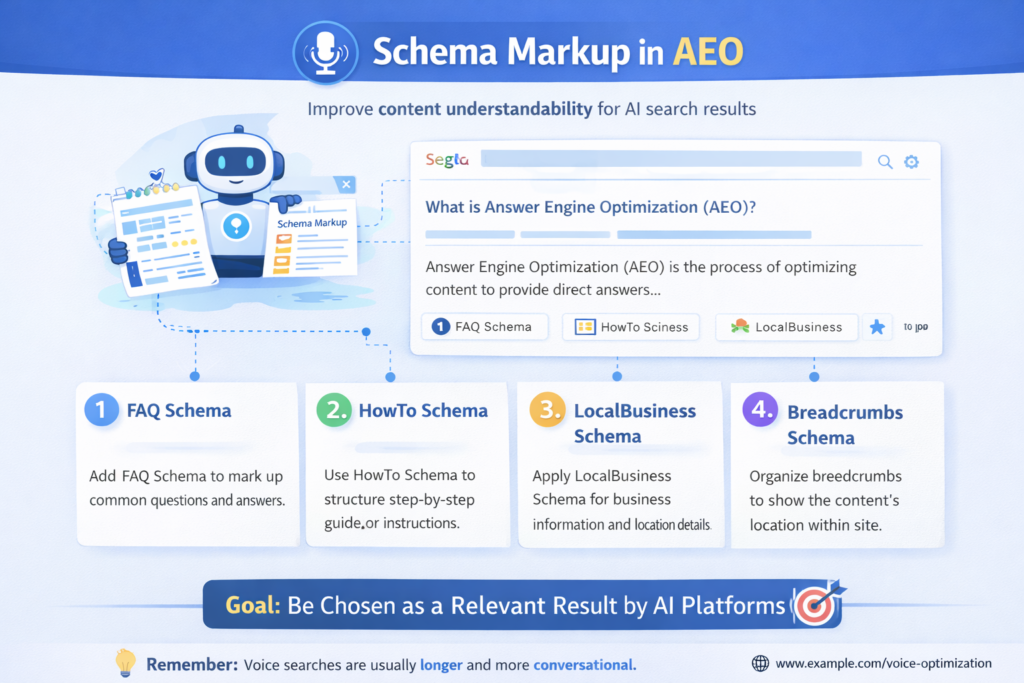
Schema markup is a type of structured data that helps search engines better understand the content of a webpage. By adding schema markup, websites can provide clear information about their content, which makes it easier for search engines and AI systems to display the information in rich results, featured snippets, and direct answers.
Using schema markup is important for Answer Engine Optimization (AEO) because it helps search engines identify questions, answers, and structured information more accurately.
Important Types Of Schema Markup
FAQ Schema
FAQ schema is used for pages that contain frequently asked questions and answers. It helps search engines display questions and answers directly in search results, improving visibility.
HowTo Schema
HowTo schema is used for step-by-step guides or tutorials. It helps search engines understand the process and sometimes display the steps directly in search results.
Article Schema
Article schema is used to provide structured information about a blog post or article, such as the title, author, and publishing date. This helps search engines better understand the content and improve its appearance in search results.
Q&A Schema
Q&A schema is used for pages where a specific question is answered. It helps search engines recognize the main question and its answer, which can increase the chances of appearing in direct answer results.
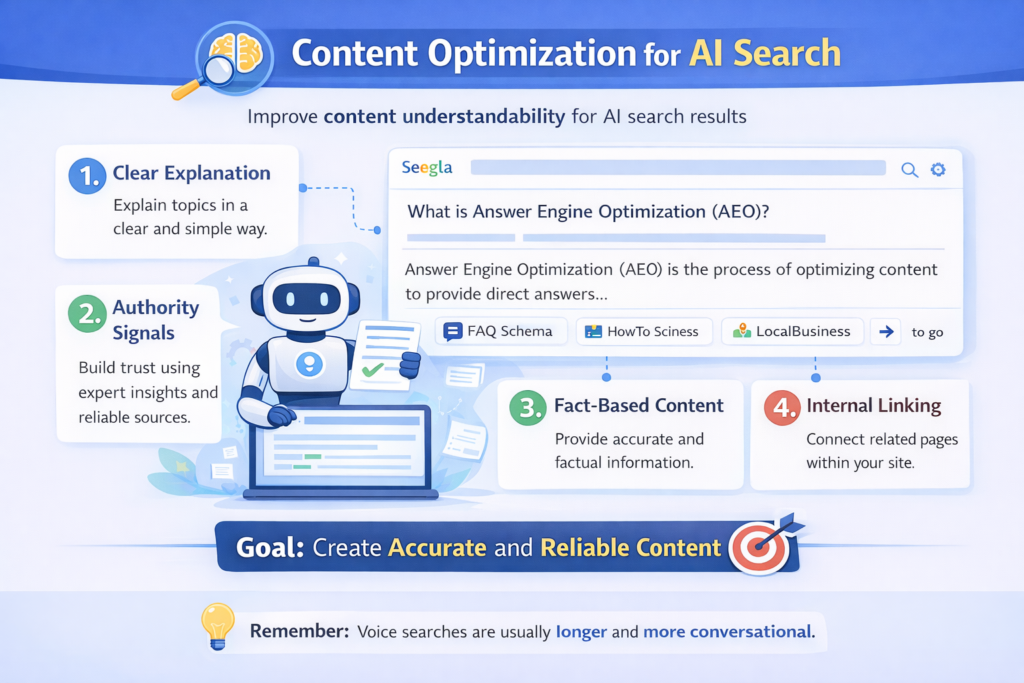
Content Optimization for AI Search
AI-powered search engines are designed to understand and summarize information to provide quick and helpful answers to users. Because of this, content should be written in a clear, structured, and reliable way so that AI systems can easily identify and use the information.
Optimizing content for AI search is an important part of modern SEO and Answer Engine Optimization (AEO), as AI platforms often select content that is accurate, well-organized, and trustworthy.
Key Strategies For Content Optimization In AI Search
Clear Explanation
Content should explain topics in a simple and clear way so that both users and AI systems can easily understand the information.
Authority Signals
Search engines prefer content that appears trustworthy and authoritative. This can include well-structured content, expert insights, and reliable sources.
Fact-Based Content
AI systems prioritize accurate and factual information. Providing clear facts and well-researched data improves the chances of content being selected as a reliable answer.
Internal Linking
Internal links help connect related pages on a website. This helps search engines understand the topic relationships and overall content structure, improving visibility in search results.
Advanced AEO Strategies
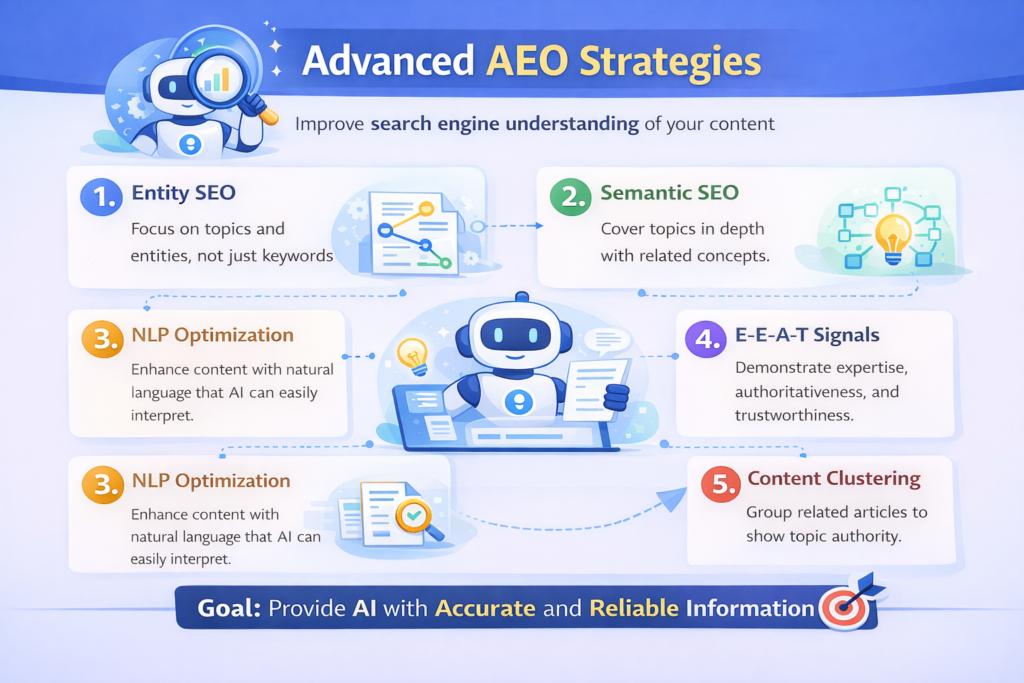
Advanced AEO strategies focus on improving how search engines and AI systems understand the meaning and context of content. These strategies help search engines identify reliable information and provide accurate answers to users. By applying advanced techniques, content becomes easier for AI-driven search systems to analyze and present as direct answers.
Important Advanced AEO Strategies
Entity SEO
Entity SEO focuses on optimizing content around specific topics, concepts, or entities instead of only keywords. This helps search engines better understand the context and relationships between topics.
Semantic SEO
Semantic SEO focuses on covering a topic in depth using related terms and concepts. This helps search engines understand the overall meaning of the content and improves topical relevance.
NLP Optimization
Natural Language Processing (NLP) optimization helps content match how search engines understand human language. Using clear sentences, natural phrasing, and well-structured information improves AI understanding.
E-E-A-T Signals
E-E-A-T stands for Experience, Expertise, Authoritativeness, and Trustworthiness. Content that demonstrates these qualities is more likely to be considered reliable by search engines.
Content Clustering
Content clustering involves creating a main topic page supported by related articles. This structure helps search engines understand the depth of a topic and improves overall content authority.